Slack Code vs Claude Tag: a room or an agent
Helio Team
Slack Code vs Claude Tag: two Slack AI launches two months apart that most comparisons get wrong. One is an agent, one is a room — Claude runs inside both.
The question both are answering
Two months apart, Anthropic and Slack shipped the same underlying conviction: AI work done privately between one person and one agent is a problem, and it belongs in a shared team surface where it can be seen, questioned and reviewed.
They answered it at different layers, which is why putting them head to head confuses more people than it helps.
What each one actually is
Claude Tag is an agent. Anthropic's model, with its own memory, permissions and billing, summoned with @Claude in a thread. It breaks a request into stages, executes against connected tools and data, and answers in the thread. Anthropic shipped it on 23 June 2026 running on Claude Opus 4.8.
Slack Code is a container. Slack shipped it on 21 August 2026 and it has no model at all. You tag a coding agent you already pay for, Slack opens a project-specific code channel, and the plan, diffs and live preview render in tabs inside it. When the task ends, the channel archives itself.
Claude is one of Slack Code's launch partners. So a Claude Enterprise customer can plausibly run both, and they do not overlap the way the naming suggests.
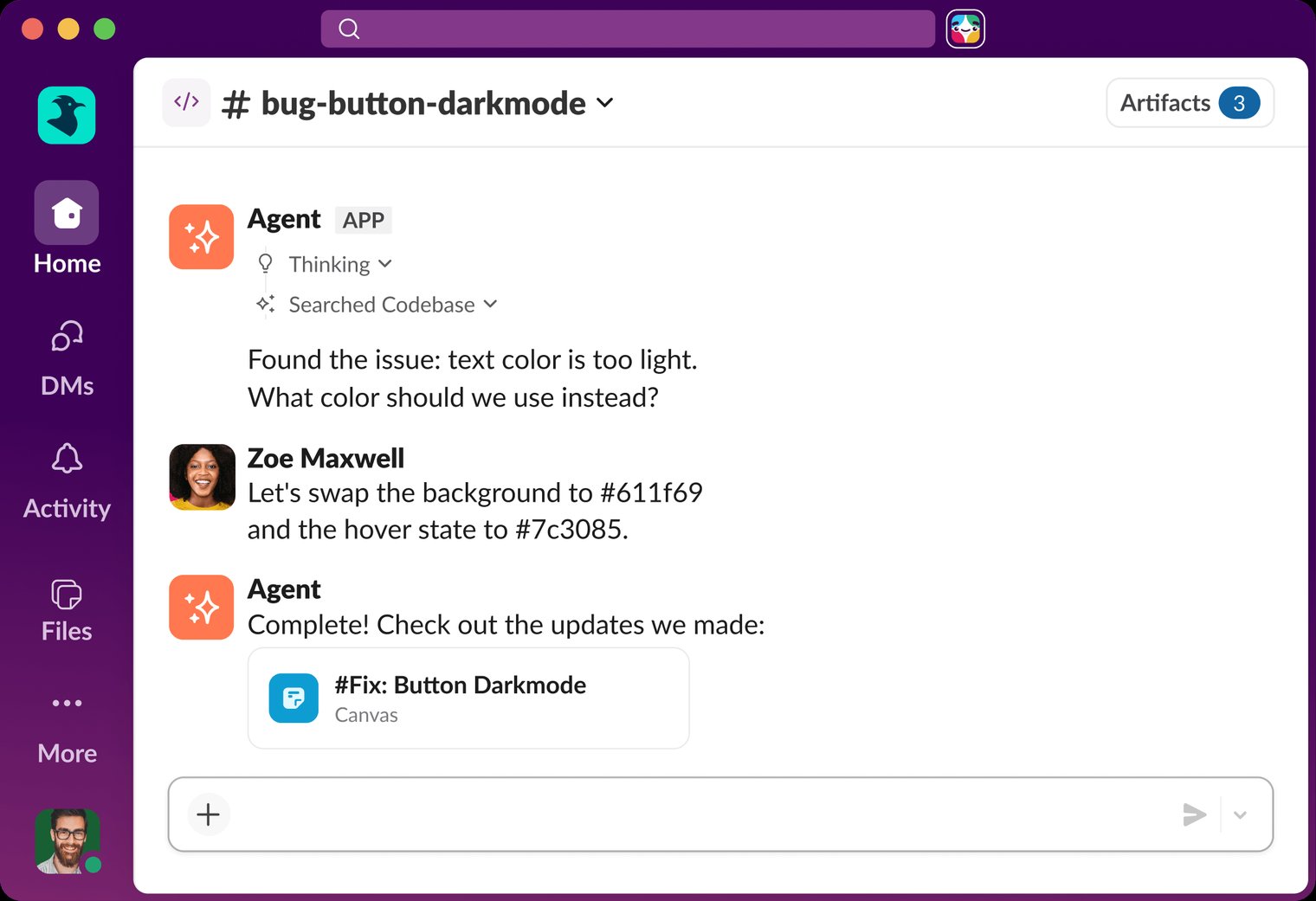
Side by side
Where the two genuinely differ, on the things that decide which one you need.
| Claude Tag | Slack Code | |
|---|---|---|
| What it is | An agent | A channel that hosts one |
| Shipped | 23 June 2026 | 21 August 2026 |
| Model | Claude Opus 4.8, Anthropic only | None of its own; Claude, Devin, Copilot, Vercel |
| Scope | General knowledge work in threads | Software development only |
| What persists | Memory scoped to admin-defined channels | An archived, searchable channel |
| Acts unprompted | Yes, with ambient behaviour enabled | No, it is a surface |
| Who can use it | Claude Enterprise and Team, in beta | Any Slack plan |
| What it costs | Billed on token spend, no published rate | Free; you pay for the agent you bring |
Where does Claude Tag win?
Memory and initiative, and neither is a checkbox difference.
It learns a channel's context over time so you stop re-explaining. It can schedule tasks for itself and pursue a project over hours or days. With ambient behaviour enabled it surfaces relevant updates without being asked. Admins scope which tools and data it reaches per channel, so a sales Claude and an engineering Claude stay separate identities with separate memories, and token spend can be capped at organisation and channel level.
It is also general. It researches, drafts, answers and works across whatever an admin connects — none of which a diff-and-preview surface is built for. Anthropic says 65% of its own product team's code now comes from an internal version of it, which is a real number even if it describes an unusually Claude-shaped company.
If the work you want handled in Slack is mostly reading, writing and deciding, this is the one. The one thing its memory is not scoped to is the job itself — a Helio teammate keeps its memory across every run of the job it owns, so week two opens with what changed rather than with whatever is still in the channel.
Where does Slack Code win?
Reach, price and the specific job of shipping software.
Its channels are free on any Slack plan, so a two-person team can turn it on today. Claude Tag cannot say that: it is beta, gated to Claude Enterprise and Team, and billed on token spending with no published rate, which we dug into in Claude Tag pricing.
It is agent-neutral, so it does not force a bet on which coding model wins, and it inherits Slack's existing permissions with nothing new for IT to audit. And its interface is built for the actual job: you do not get a diff tab because you asked for a competitor summary. If what you need is a reviewable code change that a team can interrupt mid-flight, the tabs exist for that and a thread does not.
They stack, and that is the real answer
Because Claude is a Slack Code launch partner, the honest recommendation for a Claude Enterprise customer is not to choose.
Use Claude Tag in threads for the knowledge work: the research, the summary, the draft, the question that needs an answer where the conversation is happening. Use a code channel when the output is a diff and more than one person should see it before it merges.
The one place you do have to choose is budget. If you are not already a Claude Enterprise or Team customer, Slack Code plus a cheaper coding agent gets you the visibility without the Anthropic contract, and Slack Code alternatives works through what that combination costs.
What does neither one do?
Both products stop at the same place, and it is worth naming precisely because their marketing does not.
Claude Tag remembers within the scope an admin drew. Slack Code documents what happened inside one task. Neither is accountable for the work being done at all. If nobody tags @Claude on Monday, nothing happens. If nobody opens a code channel, the backlog item sits there. The trigger is still a person deciding to start.
That is the gap we build Helio around, so weigh the next section accordingly.
| Claude Tag | Slack Code | An owner | |
|---|---|---|---|
| Who starts the job? | You tag it | You tag an agent | It does |
| Who remembers it is Monday? | You | You | It does |
| What is left when it ends? | Channel-scoped memory | An archived transcript | A teammate still on the job |
| Covers work that is not code? | Yes | No | Yes |
Where we fit, and where we do not
We build Helio, so read this as the interested party talking.
Helio is a workspace where AI teammates own recurring work. A teammate has a profile — a name, a role, a model, a lane it is accountable for — and memory that follows the job rather than a channel an admin drew a box around. Automations run on their own schedule with nobody re-prompting them, and the output lands as task updates and artifacts your team already tracks. The weekly report is the clearest case: it is not a task somebody should have to start every Monday.
Helio works in Slack too, which is the part people assume it does not: a teammate gets its own dedicated Slack app, posts into your channels, and answers when you mention it, so hiring one does not mean leaving the place your team already talks.
Where we do not fit: Claude Tag reaches further into a Slack workspace than we do, and if what you want is an agent to tag ad hoc in any thread, it is the better fit. We also do not run mass-parallel autonomous coding the way a dedicated agent does. If your problem is genuinely just that agent work is invisible until the PR lands, Slack Code fixes exactly that, for free, today.
What neither has published
Two gaps, so you do not plan around numbers that do not exist.
Anthropic has not published a per-seat or per-token rate for Claude Tag. It bills against token spending on Enterprise and Team plans, with caps you set. Any monthly figure you see quoted for it is somebody's estimate.
Slack has not published usage limits for code channels, and ChatGPT support was listed as coming soon rather than dated. Treat both as open questions rather than assuming parity with what shipped.
We publish ours, which is easy to say and worth saying anyway: Helio starts free with 1,000 credits and no card, then $16 a month billed annually, with the per-credit rate on the pricing page.
A note on the sourcing
Claude Tag details come from Anthropic's own announcement of 23 June 2026 and its documentation. Slack Code details come from Slack's launch material of 21 August 2026 and coverage of it, including Cognition's reported 10x increase in merged pull requests. Where a vendor has published no number, we say so above rather than estimate one.
If you want the adjacent comparisons: Claude Tag vs Claude Code untangles Anthropic's own two products, and Grok Bot vs Claude Tag covers the other product people put in this bracket.
Which one should you choose?
Four cases cover almost everyone.
- You are on Claude Enterprise or Team and want general AI help in threads: Claude Tag.
- You want agent coding work visible to the team and you are not paying Anthropic for seats: Slack Code, with whichever agent you already have.
- You have both available: run both. They are at different layers and Claude works inside code channels.
- The work that actually repeats is not code, and you are tired of being the one who starts it: that is the gap Helio is built for.
The one-line version
Claude Tag remembers. Slack Code documents. Helio gives the job an owner rather than giving the AI a room.
Frequently asked questions
Is Slack Code the same as Claude Tag?
No, and they are not really competitors. Claude Tag is an agent — Anthropic's model with its own memory, permissions and billing, summoned with @Claude in a thread. Slack Code is a container: Slack's channel for running somebody else's coding agent in the open. Claude is one of Slack Code's launch partners, so the two stack rather than compete.
Can you use Claude Tag and Slack Code together?
Yes. A Claude Enterprise or Team customer effectively has access to both and should treat them as complementary — Claude Tag for general knowledge work in threads, and a Slack code channel when the output is a diff that more than one person should see before it merges.
Which is cheaper, Slack Code or Claude Tag?
Slack Code, for most teams. Its channels are free on any Slack plan and you pay only for the coding agent you bring. Claude Tag requires Claude Enterprise or Team and bills against token spending, with no published per-seat or per-token rate.
What is the main difference in how they remember things?
Claude Tag accumulates channel context over time and can act without being prompted when ambient behaviour is enabled. A Slack code channel is created for one task and archives when the task ends, so what persists is the record rather than a memory. Claude Tag remembers; Slack Code documents.
Does either one own recurring work?
No. Both still need a person to start the job — someone tags @Claude, or someone tags a coding agent. Memory and visibility are upstream of ownership, which is why a weekly report or a standing backlog still lands back on a human unless something else is accountable for it.
Is there a Slack AI that owns recurring work instead of just one task or thread?
Yes. Helio also runs as a dedicated app inside Slack, so a teammate posts and answers in your channels the way Claude Tag or an agent in a Slack code channel does. The difference is what survives: a Helio teammate keeps its identity and memory across jobs rather than a channel that archives or a memory scoped to one thread, so the same teammate is still on the weekly report, the inbox or a deploy watch the following week.