What is Claude Tag? Anthropic's @Claude in Slack
Helio Team
What is Claude Tag? Anthropic's @Claude inside a Slack channel. What it does, how its memory works, and why teams running recurring work end up looking past it.
The short answer
Claude Tag is Anthropic's @Claude living inside a Slack channel. You mention it in a thread, hand it a task, and it works asynchronously over minutes or hours, then posts the result back where you asked.
That is the whole product in one sentence. The interesting part is what it implies.
It is not a chat window you visit. It sits where the team already talks, which means the work and the discussion about the work land in the same place. Anthropic shipped it on 23 June 2026, and within 2 months it had its own category of comparison articles.
Which Claude is this?
Anthropic ships three things with Claude in the name, and buying the wrong one is expensive.
- Claude is the model family: Opus, Sonnet, Haiku. The intelligence inside the products, not a product you deploy.
- Claude Tag is @Claude inside a Slack channel. This article is about that.
- Claude Code is a developer tool that edits a codebase directly, run from the terminal, IDE, web or Slack. We covered the split in Claude Tag vs Claude Code.
What Claude Tag can do
The capabilities that separate it from a Slack bot with an AI label.
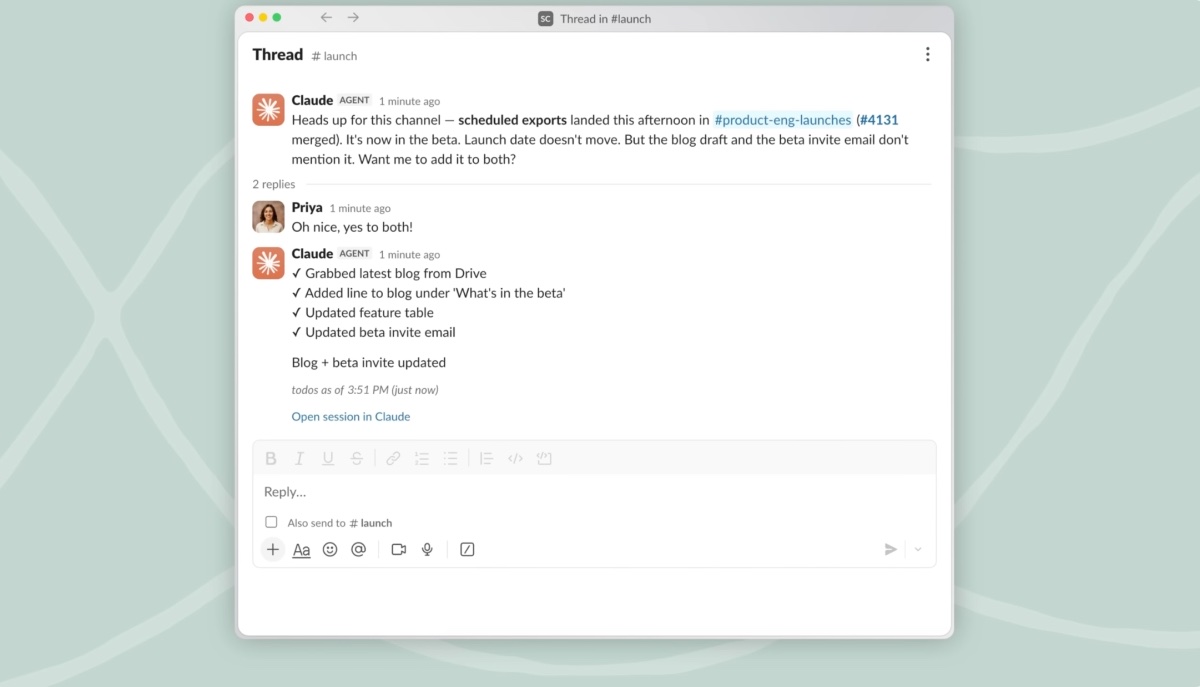
- Asynchronous work. You delegate and close the tab. It posts when it is done rather than answering in one turn.
- Multi-step tasks. Inside a job it decides what to do next and checks back without being re-prompted.
- Ambient behaviour. It can watch a channel and act when a thread goes quiet, instead of waiting to be tagged every time.
- Connected tools. It launched with roughly 14 integrations, including Asana, Datadog, GitLab, Gmail, Google Calendar, Google Drive, HubSpot, Linear, Notion, PagerDuty, Sentry, Stripe and Vercel.
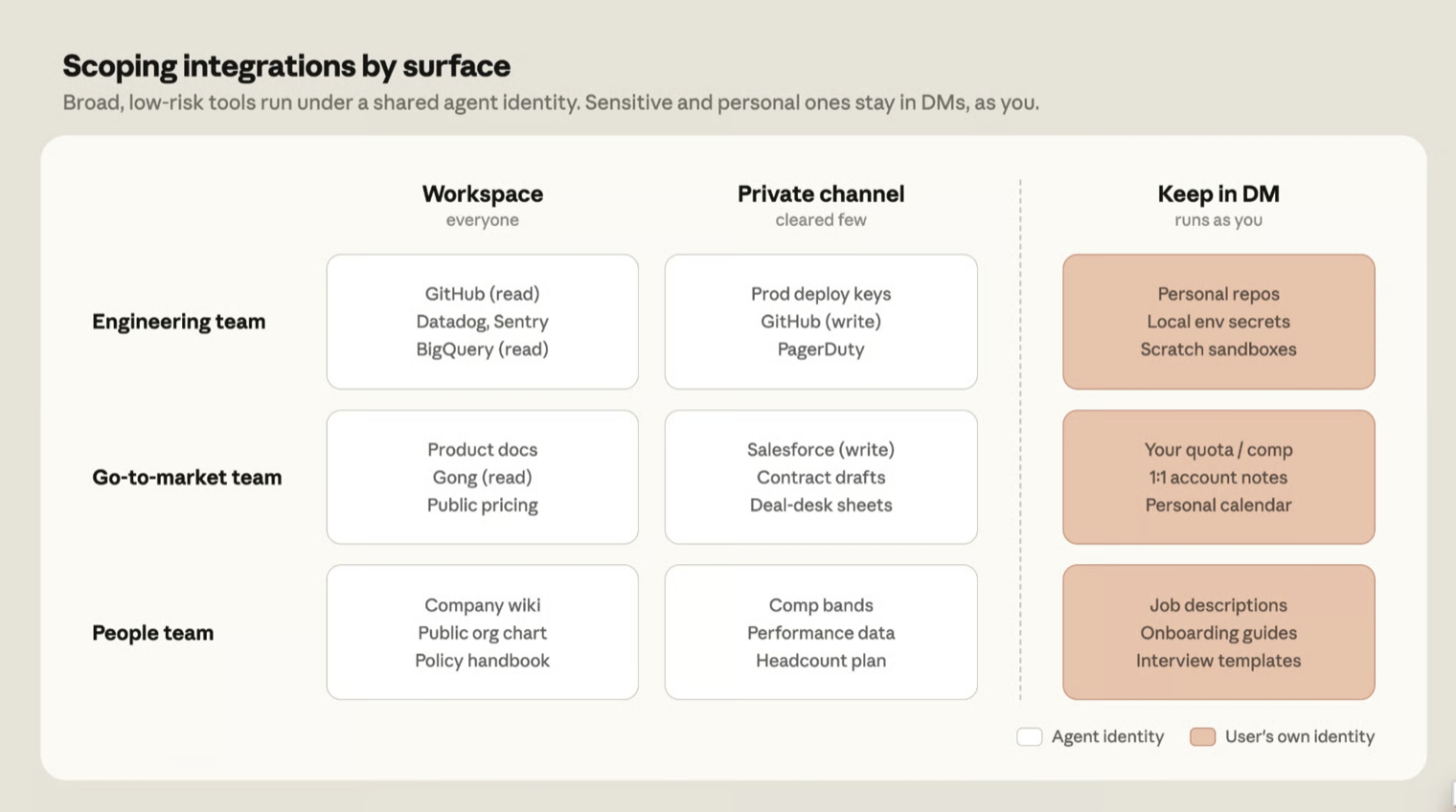
- Scoped access. Admins control what it can reach, and delegated tasks then run inside those bounds.
- A schedule exists: it can schedule tasks for itself and keep standing triggers in a channel. What is missing is a job it owns end to end — each trigger fires a task inside one channel's scope, and nothing follows the work between rooms.
How the memory works, and why it matters
This is the part most explanations skip. It decides more than the feature list does.
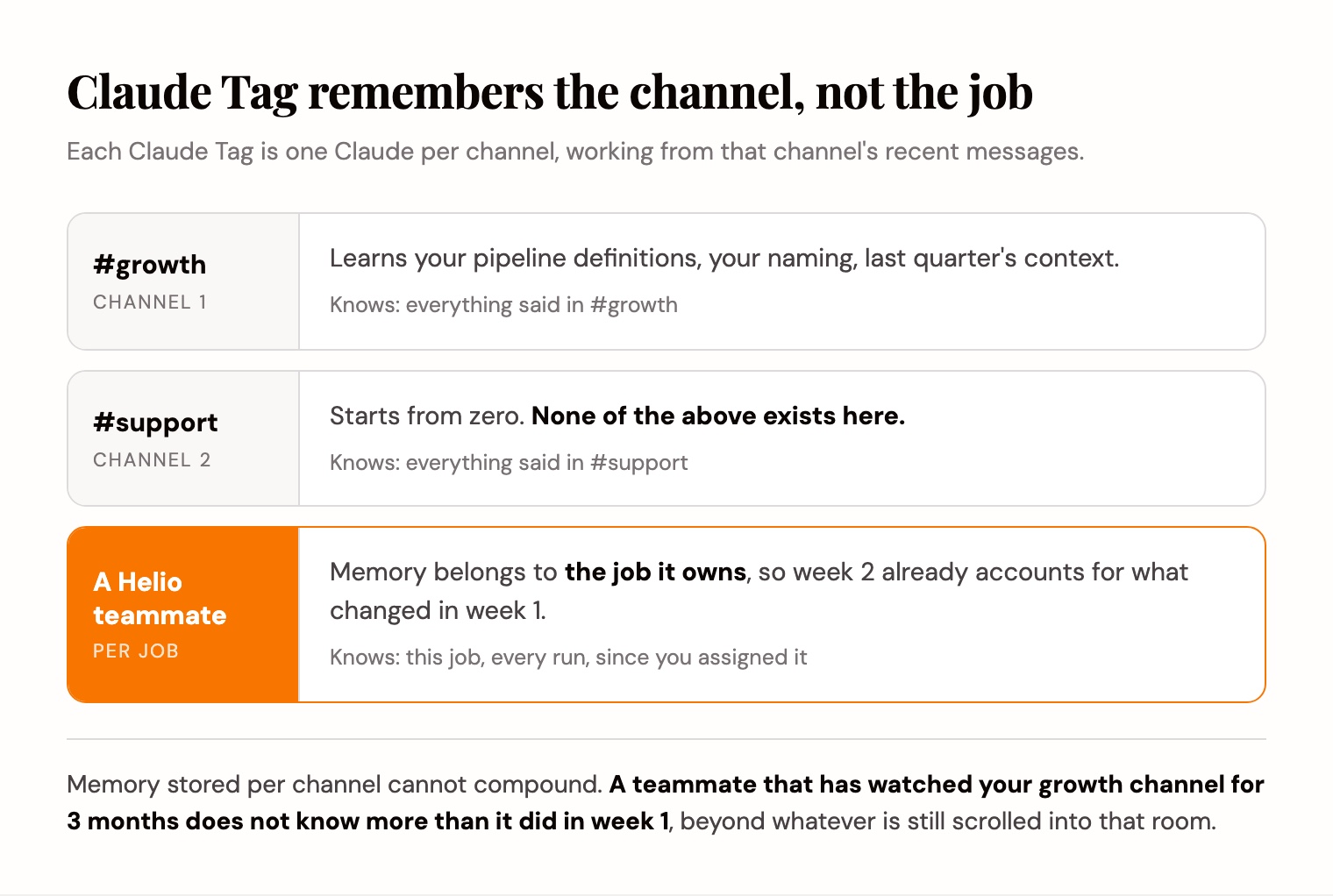
Memories are scoped to the Claude identities and channel sets an administrator defines, and Anthropic says Claude can learn from other channels and data sources when granted permission. Inside its scope, each Claude works from that channel's conversation — so the thing you spent twenty minutes explaining in #growth on Tuesday is not there when someone asks a related question in #support on Wednesday, unless an admin scoped those rooms together. Across the boundary, ask it twice, explain it twice.
That design keeps things contained. For access control, that is a real benefit.
It also means knowledge does not compound across the workspace. A teammate that has watched your growth channel for 3 months knows that scope well, and carries none of it into any room outside it.
The alternative is to scope memory to the job instead of the room. In Helio a teammate owns a recurring job and keeps its own memory across every run of it, so week 2 opens with what changed since week 1 rather than with whatever is still visible in the channel. Same idea, different unit.
Where the memory actually lives
Two ways to scope the same thing, and the unit decides what compounds.
How access and identity work
Admins scope what Claude Tag can reach. That scoping quietly decides two things at once: what it is allowed to touch, and what it reads.
Broad, lower-risk tools run under a shared agent identity at the workspace and channel level, while the sensitive and personal ones stay in direct messages and run as you, which is a sensible split, and Anthropic backs it with an Audit view of scheduled and one-time tasks, with actions traceable back to the Slack thread that started them. What your downstream systems log natively, though, is the shared agent identity: proving who asked means following the trail back into Slack rather than reading it off the tool's own record.
For most teams that is fine. If your auditor wants the requester in the downstream system's own records, it is the first thing they will ask about.
We went the other way. Each Helio teammate gets its own dedicated Slack app rather than sharing one bot identity, so the log names the teammate that did the work.
Anthropic's own description
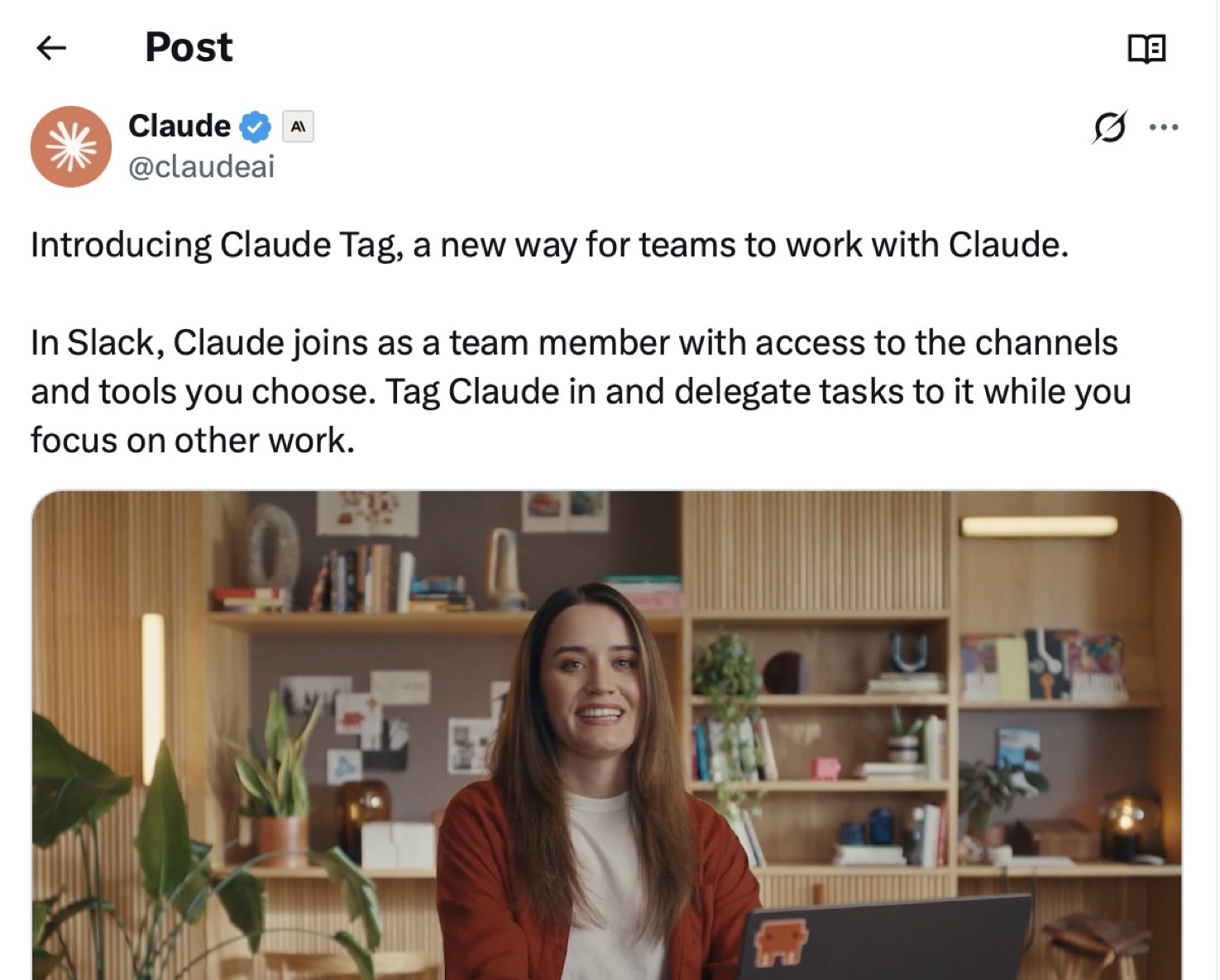
Worth reading the announcement wording, because it is precise about the shape: Claude joins as a team member with access to the channels and tools you choose, and you tag it in to delegate tasks while you focus on other work.
Delegate is the operative verb. Every sentence in that description starts from a person deciding to hand something over.
Who can use it, and what it costs
Claude Tag is in beta for Claude Enterprise and Team plans, the 2 tiers it is gated to. If your team is not on one of those, you cannot turn it on. That settles the evaluation before it starts.
There is no published per-seat or per-token rate. It bills against token-based spending with administrative spend controls. What you actually pay tracks how many channels it monitors and how much gets delegated to it, so two teams on the same plan can differ by a lot. We went through the cost drivers in Claude Tag pricing.
Where it stops
None of these are about intelligence. They are about reach and shape, which is a harder thing to fix with a better model.
- Slack only, and in beta. Microsoft Teams, email and project tools are a stated plan, not something it does today. Helio does not do Microsoft Teams either, so that limit is shared.
- The connector list is short and you cannot extend it yourself from inside Slack.
- It runs Anthropic models only, so there is no routing a cheap high-volume task elsewhere.
- Memory is scoped to admin-defined channel sets, so knowledge does not follow work across the workspace by default. Helio scopes memory to the job instead, which is the single biggest design difference between the two.
- It centres on the single handoff. Scheduled tasks and standing triggers exist, but each run is a task inside one channel's scope. An owner model carries the job itself — context, judgment, delivery — from one Monday to the next, which is the shape Helio takes.
What it does not do
The last limit catches teams out. It is a shape, not a missing feature, so no amount of shipping fixes it.
Claude Tag is excellent at the task you hand it. The problem is the task that comes back next Monday.
You can put it on a schedule, and the run still arrives shaped like week 1: the memory behind it is scoped to its channels rather than the job, so what changed since last time is yours to re-explain.
A cron job can wake up on time. A workflow can run fixed steps. An agent can finish a task once. Recurring work needs someone who knows what changed, what matters, and where the result should go.
That is the job we built Helio around, so weigh what follows accordingly. Helio is a workspace where AI teammates own recurring work: you give one a name, a role, and a job that comes back, and it delivers the result on its own schedule. It runs in Slack as well as its own channels.
The two differences that matter here are the ones this article already walked through.
Memory attaches to the job rather than the room, so a teammate opens week 2 with what changed since week 1 instead of with whatever is still scrolled into a channel. And nobody re-briefs it. The weekly report arrives because it is Monday, not because someone remembered.
Neither of those makes Claude Tag worse at what it does. It is a strong task runner, and if your work is genuinely one-off, a task runner is the correct purchase. The question is only whether the work comes back.
If you are weighing options rather than learning what it is, we compared eight of them in Claude Tag alternatives.
Frequently asked questions
What is Claude Tag?
Claude Tag is Anthropic's @Claude living inside a Slack channel. You mention it in a thread, hand it a task, and it works asynchronously over minutes or hours before posting the result back to the thread. It shipped on 23 June 2026 on Claude Enterprise and Team plans.
How does Claude Tag work?
You tag @Claude in a Slack thread with a task. It reads the recent messages in that channel for context, works asynchronously through multiple steps, uses whichever connected tools an admin has scoped for it, and posts the result back in the thread.
What can Claude Tag do?
Asynchronous multi-step work that starts in a conversation: summarizing threads, pulling numbers from connected tools, drafting replies, researching. It launched with roughly 14 integrations including Gmail, Google Drive, HubSpot, Linear, Notion, Sentry, Stripe and Vercel.
Is Claude Tag the same as Claude in Slack?
Yes. Claude Tag is the current name, and it replaced the earlier Claude in Slack integration with a 30-day window to migrate.
Does Claude Tag remember things?
Yes, within the scope an admin defines. Memories stay attached to a Claude identity and its channel set, and it learns from other channels and sources only when granted permission, so what it learns does not follow a job across the workspace by default.
Who can use Claude Tag?
It is in beta for Claude Enterprise and Team plans. It is not available on free or individual plans, and it works in Slack only. Microsoft Teams and email are a stated plan rather than something it does today.
How much does Claude Tag cost?
Anthropic has not published a per-seat or per-token rate. It bills against token-based spending with administrative spend controls, on top of an Enterprise or Team plan.
Is there an alternative for work that repeats every week?
That is the specific gap. Claude Tag can schedule tasks and standing follow-ups, but each run stays a task inside its channel scope with nobody owning the job. Helio, which we build, assigns a recurring job to an AI teammate that keeps memory attached to the job rather than the channel and delivers on its own schedule. It runs in Slack too, so it is not a question of leaving the channel you already work in.