Claude Tag alternatives: 8 options compared
Helio Team
The best Claude Tag alternative depends on why you are leaving. 8 options compared by the job each does best, plus where Claude Tag still wins.
How we compared these
We used five questions that actually separate these products, not a generic feature checklist.
Does it handle recurring work, or only one-off tasks? Where does it live: Slack, Microsoft Teams, both, or its own workspace? What does it hand you, a chat reply or a finished deliverable? Who maintains it, you or the vendor? And can you find the price without a sales call?
Pricing below comes from each vendor's own pages as of August 2026. Where a vendor does not publish one, we say so instead of guessing. Helio is our own product, which we note plainly rather than hide.
Claude Tag alternatives at a glance
A quick read on each, by the job it does best and what it costs.
| Tool | Best for | Pricing |
|---|---|---|
| Helio | Recurring work that needs a long-term owner | Free tier, then from $16/mo |
| Viktor | Widest tool reach, and Microsoft Teams | $100 in free credits, then from $50/mo |
| Glean | Enterprise-wide knowledge search | Quote only |
| PromptQL Tag | Per-user permissions and running in your own cloud | Usage-based, from $0.14 per OLU |
| eesel AI | Resolving customer support tickets | $0.40 per ticket |
| Lindy | Personal delegation across inbox and calendar | From $29.99/mo |
| Slack AI and Microsoft 365 Copilot | Summaries and recaps, with no new vendor | Basic AI free; from $7.25 and $30 per user/mo |
| Open-source Slack agents | Full self-hosting and total control | Free, self-hosted |
First, be precise about which Claude you mean
The naming is confusing, and buying the wrong thing is an expensive mistake.

- Claude is the model family: Opus, Sonnet, Haiku.
- Claude Tag is Anthropic's @Claude living inside a Slack channel. You tag it, hand it a task, it works asynchronously and posts the result back to the thread. That is what this article is about.
- Claude Code is a separate developer tool for coding, run from the terminal, IDE, web or Slack. If you are looking to replace that, this is the wrong list.
What Claude Tag gets right
Credit where it is earned. We are not going to pretend it is a chatbot with a new name.
Anthropic shipped it on 23 June 2026, and it works asynchronously over hours or days, so you can delegate and close the tab. It takes multiple steps inside a task without being re-prompted. It runs on Claude Opus 4.8, one of the strongest reasoning models you can buy. It lives where the team already talks, which is most of why it spread so fast. And admins can scope what it reaches.
If your team is technical, standardized on Anthropic, and happy to wire up and maintain its own connectors channel by channel, Claude Tag is a strong choice and you may not need this list at all.
Why teams go looking anyway
Six reasons come up over and over. None of them are about intelligence.
- It is Slack-only, and in beta. Microsoft Teams, email, and project tools are a stated plan, not something it does today. It also replaced the older Claude in Slack app, with a 30-day window to migrate.
- The connector list is short. It launched with roughly 14 integrations; admins decide what it reaches, and you cannot add a tool yourself from inside Slack.
- It is locked to Anthropic models, so there is no routing a cheap high-volume task elsewhere and no fallback.
- Memory is scoped to the channel sets an admin defines. It can learn from other channels and sources when granted permission, but nothing follows the work anywhere an admin has not scoped it, so the same facts get re-explained across silos.
- In channels it acts as a shared agent identity: the Audit view can trace an action back to the thread that asked, but your downstream systems' own records name the bot.
- Pricing is a question mark: Enterprise and Team plans only, billed on token spending, with no published usage rate.
The question these lists skip: does this task come back?
Every other Claude Tag alternatives roundup compares the same five things, and every one of them quietly accepts the same product shape. You ask. It works. It delivers. It disappears.
That shape is correct for a lot of work. Research this vendor. Summarize this thread. Pull these numbers, once.
It is wrong for the work that actually eats your week: the weekly status report, the Monday pipeline review, the competitor watch, the customer feedback digest, the month-end close. That work does not need a better one-off executor. It needs someone to own it.
| A task runner | An owner | |
|---|---|---|
| Who remembers it is Monday? | You | It does |
| Who notices the data source changed? | You | It does |
| Who decides what is worth including this week? | You | It does |
| Who re-explains last quarter's context? | You, every time | Nobody, it kept it |
| What happens when you are on holiday? | Only what you scheduled runs | It runs, and adjusts |
Four shapes of AI at work
A cron job can wake up on time. A workflow can run fixed steps. An agent can complete a task once. But recurring work needs someone who knows what changed, what matters, what should be said, what should be skipped, and where the result should go.
We are not claiming the first three rows below are wrong. We are claiming the fourth is mostly empty, and that a lot of what people want off their plate lives there.
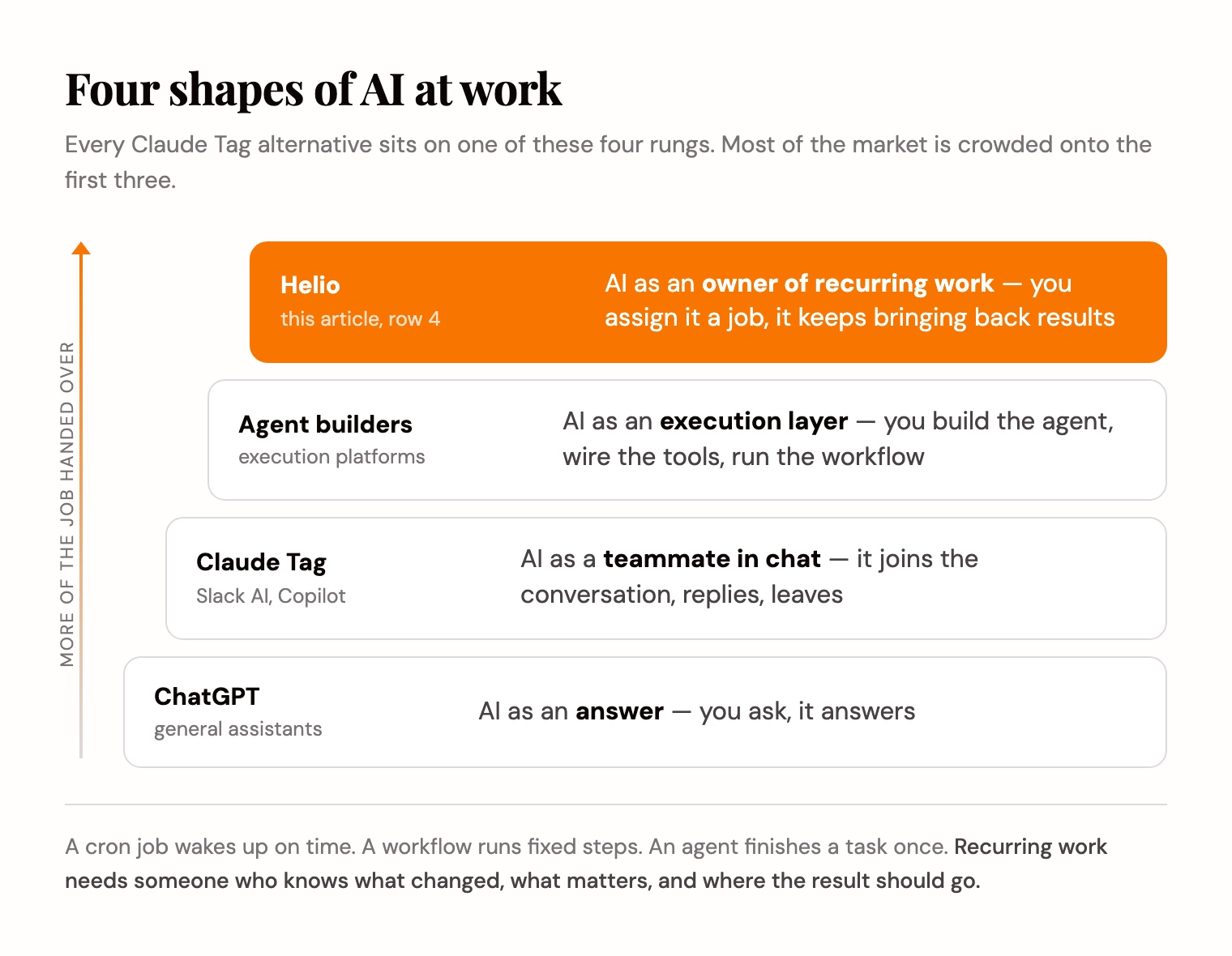
| Category | The mental model |
|---|---|
| ChatGPT | AI as an answer. You ask, it answers. |
| Claude Tag, Slack AI | AI as a teammate in chat. It answers in the room, and the job stays with you. |
| Agent builders and execution platforms | AI as an execution layer. You build the agent, wire the tools, run the workflow. |
| Helio | AI as an owner of recurring work. You assign it a job, it keeps bringing back results. |
1. Helio
Helio is a workspace where AI teammates own the recurring work that needs context, judgment, and delivery. You do not build a workflow and maintain it. You give a teammate a job, the way you would give it to a new hire, and it keeps doing that job.
Each teammate has a profile: a name, a role, a model, and a lane it is accountable for. Memory holds your standards and past calls across sessions, not per channel, so it never starts from zero. Automations run on their own schedule, and nobody re-prompts them. Output lands as task updates on the board your team already tracks, and as artifacts you reopen by link.
The clean way to hold it against Claude Tag: Claude can join a Slack channel and follow the conversation. Helio lets you assign an AI teammate to a workflow, to watch the sources, make the call, write the update, and deliver it every week. The difference shows up on the second run. With a task runner, week two is week one again. With an owner, week two already accounts for what changed.
Helio is a shared workspace rather than a bot bolted onto yours. You invite colleagues by email, and people and AI teammates work in the same channels. Each teammate gets its own dedicated Slack app rather than one shared bot identity, so you can see which teammate did what. Teammates run on Helio Cloud by default, or on your own machine for local file access and data privacy.
- Best for: recurring work that needs a long-term owner, in a workspace your team joins.
- Key features: per-teammate memory and identity, scheduled automations, skills, shared channels with people, artifacts and task boards, bring your own Anthropic, OpenAI, or DeepSeek keys.
- Connects to: GitHub, Slack, Gmail and Google Workspace, Notion, Discord, Figma, LinkedIn, X, your Chrome browser, plus a skills catalog (full list). Admins connect once; each teammate gets only the slice it needs.
- Limits: no Microsoft Teams, and the platform is not self-hostable. Running a teammate on your own machine is not the same as running Helio in your VPC, and we will not blur those.
- Pricing: free to start with 1,000 credits, no card required. Pro from $16/mo billed annually, Max from $80/mo. See full pricing.
2. Viktor
Viktor positions itself as an AI employee living in Slack and Microsoft Teams, claiming 3,200+ connected tools against Claude Tag's 14, with model choice set per task, scheduled jobs, browser automation, and finished deliverables posted back to the channel.
It is the most direct functional competitor to Claude Tag on the market. If breadth of reach is your binding constraint, Viktor is probably the answer rather than us, and we take that trade one-to-one in Helio vs. Viktor. Where we differ is emphasis: Viktor is built around what an AI employee can reach, we are built around what it owns over time.
- Best for: the widest tool reach from a chat message, and Microsoft Teams coverage.
- Limits: it cannot join a live call, and there is no per-member persistent machine where sessions compound between runs.
- Pricing: $100 in free credits to start, then credit tiers from $50/mo; enterprise is custom.
3. Glean
If what you liked about Claude Tag was one assistant that knows what the company knows, Glean is the closest true peer. It builds a permissions-enforced knowledge graph from 100+ connectors including Slack, then layers search, an assistant, and an agent builder on top. It raised a $150M Series F at a $7.2B valuation and passed $100M ARR, so this is a serious platform rather than a bet.
It is a knowledge assistant, not an owner of operational work. It finds things; it does not run your Monday.
- Best for: big companies where finding things is the real bottleneck.
- Limits: enterprise-only, and it does not run a ticket queue or a recurring deliverable.
- Pricing: not published. Per-seat plus a metered credit layer; secondary sources put the practical floor around 100 seats and $50,000 a year.
4. PromptQL Tag
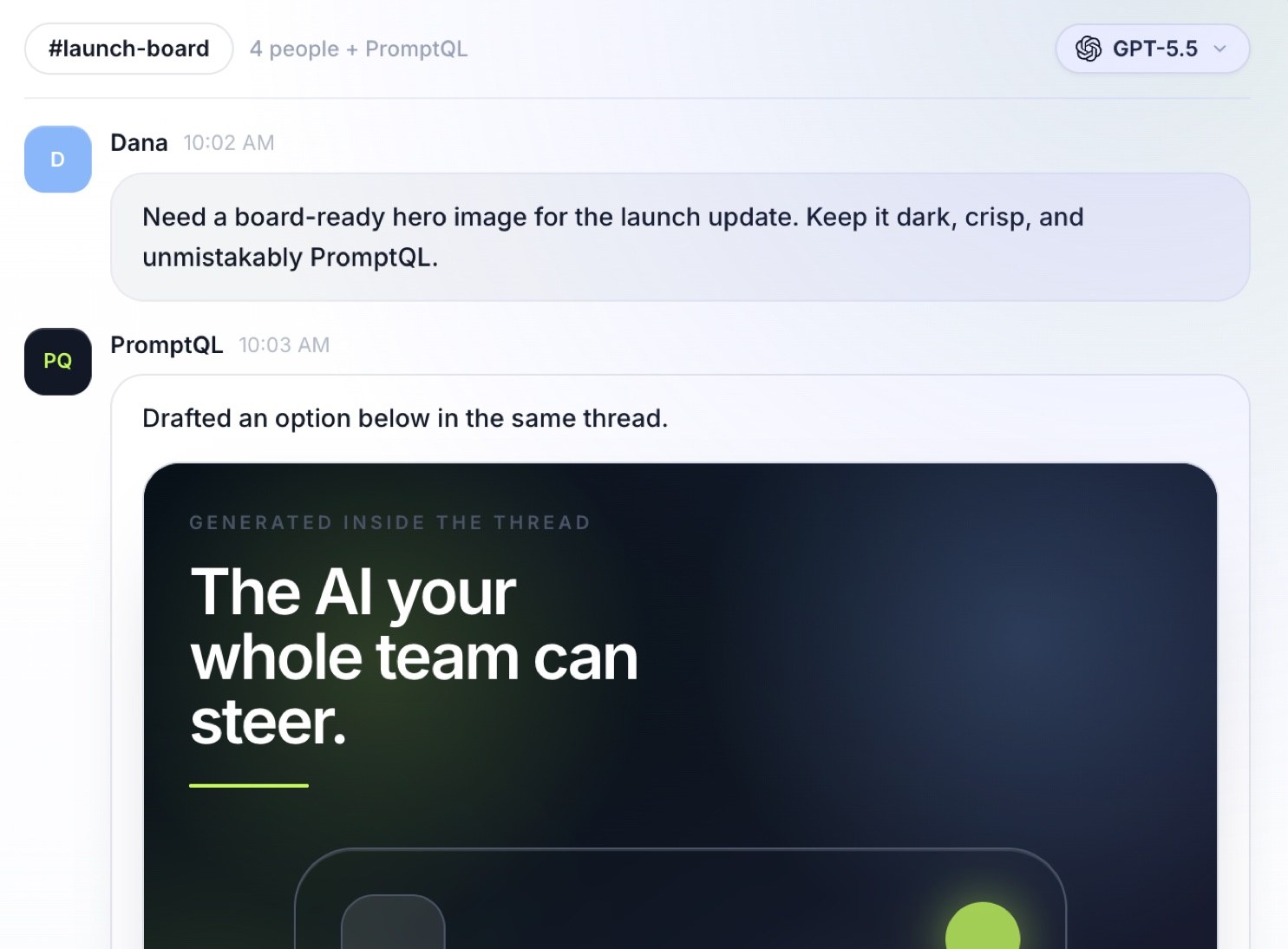
PromptQL Tag's pitch is ownership of the AI itself: your brand and name in the channel, any model, one shared org-wide context wiki instead of channel-scoped memory, and, the interesting part, it acts as the real person who tagged it. Audit logs show the actual human rather than a bot. Enterprise runs in your own cloud.
If your security team is the one blocking Claude Tag, start here. This is the exact block it was built to clear.
- Best for: teams where whose permissions the AI used is a question your auditor asks.
- Limits: it is a context and access platform more than a work owner. You still decide what runs and when.
- Pricing: usage-based and published, $0.14 per OLU introductory and $0.20 standard, with free credits to start.
5. eesel AI
eesel joins Slack as an AI teammate you mention, and also connects to Zendesk, Freshdesk and others so it can draft and resolve tickets. It covers 100+ integrations and 80+ languages, learns from your past tickets, and escalates anything it is not sure about instead of guessing. You can simulate against historical tickets before it touches a live customer.
If Claude Tag alternative really means AI that closes our support queue, this is a more direct answer than anything else here, including us.
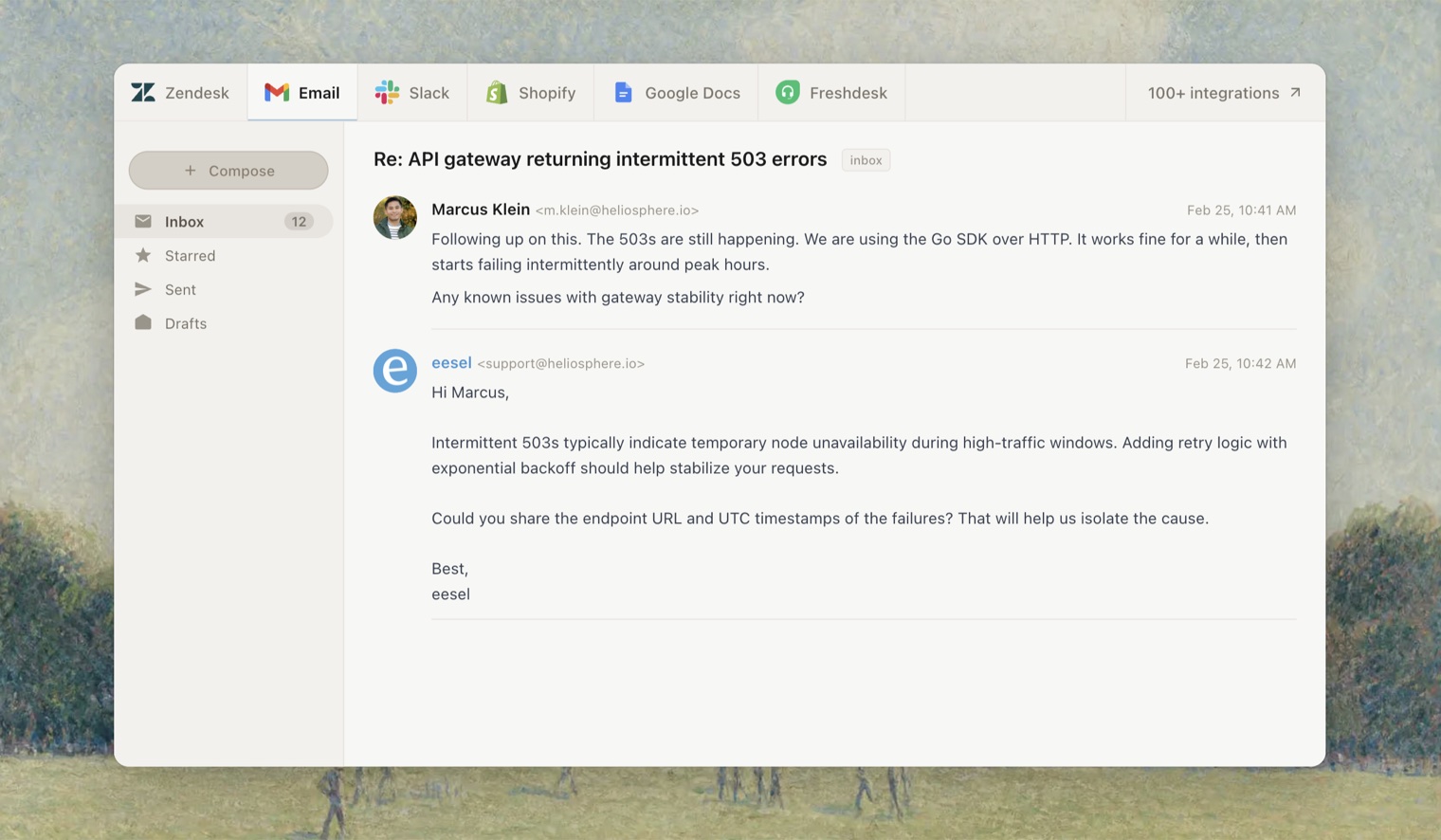
- Best for: support and ops teams that want AI in Slack and in the helpdesk.
- Limits: a support specialist. It will not write your product code or run your growth reporting.
- Pricing: $0.40 per ticket, no per-seat fee, with $50 of usage in the free trial. Enterprise adds a $1,000 per month platform fee.
6. Lindy
Lindy is an agent builder aimed at the executive-assistant job: inbox triage, meeting prep, calendar, CRM updates, with a large integration catalog and per-agent configuration.
It is the right pick when the work is yours personally rather than the team's. Team-level ownership is where it gets thinner.
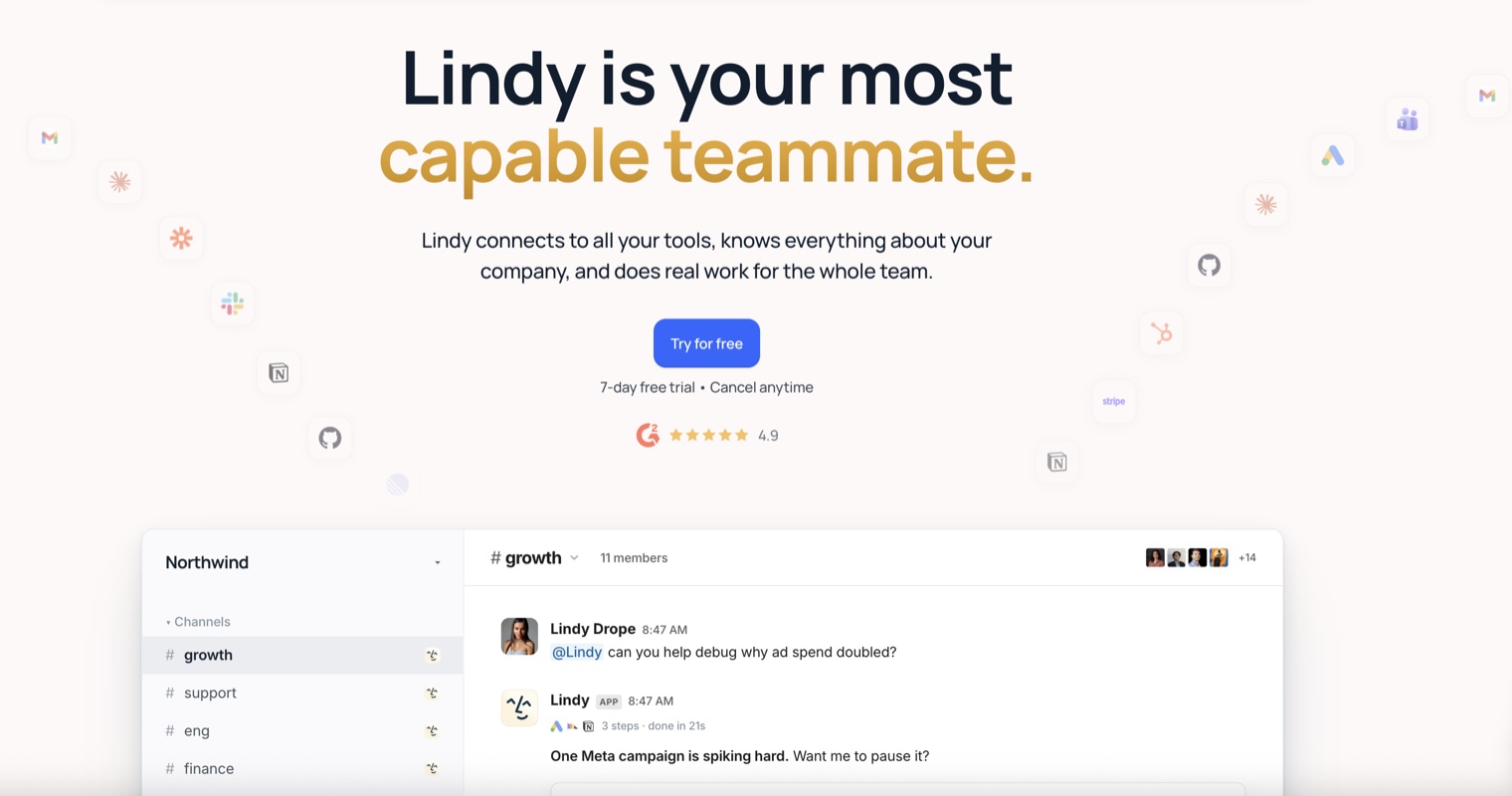
- Best for: one person or a small team handing off email, meetings, and follow-ups.
- Limits: credit-based pricing gets expensive on complex multi-step workflows, and you configure the agents yourself.
- Pricing: 7-day free trial, then $29.99/mo for Plus, $99.99 for Pro, and $199.99 for Max.
7. Slack AI and Microsoft 365 Copilot
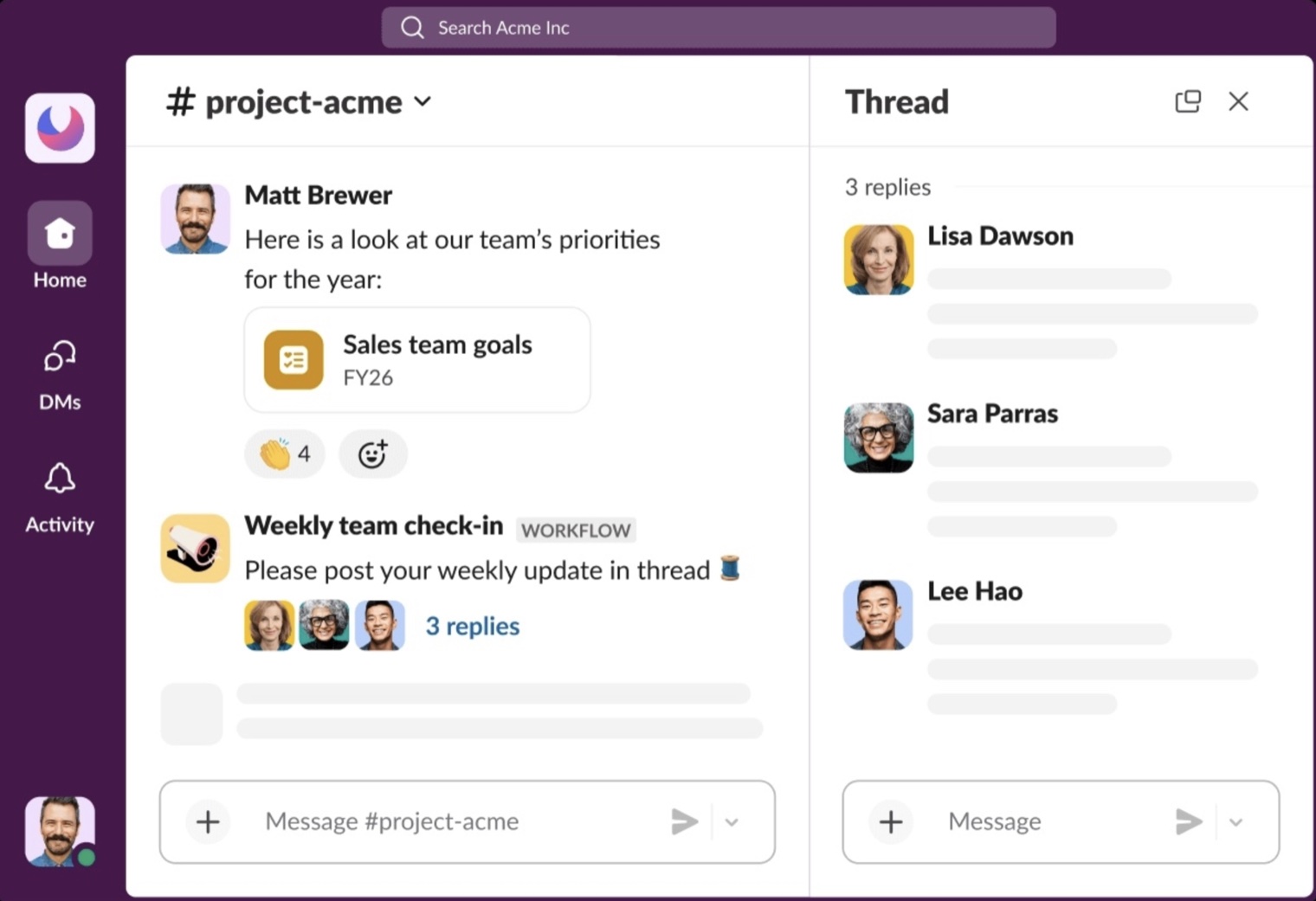
Slack AI covers native summaries, recaps, search, and Slackbot inside the tool you already pay for. Microsoft 365 Copilot is the equivalent for Microsoft Teams companies, with Graph context across mail, files, and meetings.
These summarize and retrieve, and on Business+ plans Slack's AI workflow steps can post a scheduled channel recap. What neither has is an owner: a workflow re-runs fixed steps over the sources you wired, with no judgment about what changed and no context carried between runs. If the honest answer to what would AI do for us is help us catch up on channels, buy the one you already have and stop shopping.
- Best for: teams whose real problem is chat overload, not work overload.
- Limits: fixed-step workflows at best; nothing owns the job or carries context between runs.
- Pricing: basic AI features ship on Slack's free plan; Slack Pro from $7.25 per user/mo billed annually. Microsoft 365 Copilot $30 per user/mo, billed annually.
8. Open-source Slack agents
Several open-source projects now replicate the core pattern: read a Slack thread, call tools, render rich results, bring your own model including local ones, self-host everything. OpenHands is the broader open agent platform; Cyrus markets itself as the open-source Claude Tag alternative, though in practice it is a Linear-plus-Claude-Code coding agent rather than a general teammate.
Genuinely the right answer for teams with the engineers to run it and a hard requirement that data never leaves. For everyone else, the maintenance cost is larger than it looks on day one.
- Best for: engineering teams that want the Claude Tag pattern with no closed runtime.
- Limits: you own the setup and every outage. No SLA, and the UX lags managed products by a wide margin.
- Pricing: free, minus your engineering time.
The full comparison
The five dimensions that separate these products, side by side.
| Owns recurring work | Slack | MS Teams | Model choice | Self-host | Price published | |
|---|---|---|---|---|---|---|
| Claude Tag | Scheduled tasks, no owner | Yes | No | Anthropic only | No | No |
| Helio | Yes | Yes | No | Yes, BYO keys | No | Yes, free tier |
| Viktor | Scheduled jobs | Yes | Yes | Yes | No | Yes |
| Glean | No, knowledge | Yes | Yes | Not applicable | No | No |
| PromptQL Tag | No, context layer | Yes | Yes | Yes | Yes, VPC | Yes, per OLU |
| eesel AI | Yes, for tickets | Yes | No | Not applicable | No | Yes |
| Lindy | Partial | Yes | No | Not applicable | No | Yes |
| Slack AI, Copilot | Scheduled recaps | Yes | Copilot only | No | No | Yes |
| Open source | Depends on you | Yes | Varies | Yes | Yes | Free |
When Claude Tag is still the right answer
We would rather you buy the right thing than buy ours.
- You are already on Claude Enterprise or Team, so there is no new plan to buy — usage still meters against your organization's spend caps, but evaluating needs no new contract. We go head-to-head with Anthropic in Helio vs. Claude.
- Your work is genuinely one-off: research, analysis, drafting, on demand.
- You are all-in on Anthropic and see no reason to change.
- You have engineers who want to own the connector and permission setup.
- The tools you need are already inside its connector list.
- You want a coding agent. For deep engineering across a large codebase, use Claude Code. Nothing on this list is a like-for-like swap, and we will say that plainly.
Where we fall short
Four honest limits, so you can rule us out fast if they matter.
We are not self-hostable. Helio runs as a hosted product. Running a teammate on your own machine keeps files and tools local, but the platform does not run inside your VPC. If your security review requires that, PromptQL Tag or an open-source runtime is your answer, not us.
We do not support Microsoft Teams. If that is where your company works, Viktor or Copilot covers you.
Recurring is our shape. If most of your work is genuinely unpredictable and one-off, an owner is the wrong abstraction and Claude Tag is a good task runner.
A vague job produces a vague result, and a tool we cannot see is a blind spot. Keep an eye on the competition is not a job description. The teammates work well when the brief is as specific as one you would give a person.
How to choose
Answer these in order and the list narrows fast.
- Does the work come back? If yes, you want an owner. If no, a task runner is cheaper and simpler.
- Where does your team actually work? Microsoft Teams companies should look at Viktor, PromptQL Tag, or Copilot. Claude Tag does not cover you, and neither do we.
- Who is blocking the purchase? If security, PromptQL's per-user permission model answers that objection best. If finance, look for a published price.
- Is the real job support? Then buy a support tool. eesel and its peers will beat a generalist on ticket resolution.
- Does the model need to run on your hardware, or the whole platform? These are different requirements and vendors blur them.
- Do you have engineers who want to own it? If you are hesitating on that question, the answer is no.
The one-line version
Claude Tag made it normal to hand work to an AI in the channel where you already talk. That was the hard part, and Anthropic did it well.
The next problem is smaller and more annoying: the work that comes back. If you are the one who remembers it is Monday, you have not actually handed it off yet.
That is the gap we build for. In Helio a recurring job gets a named AI teammate that owns it, keeps its memory between runs, works in your Slack channels, and delivers the weekly result on schedule. It starts free with 1,000 credits and no card, so the honest way to test any of this is to hand over one job that comes back and see whether you think about it again.
Frequently asked questions
What is the best Claude Tag alternative?
It turns on why you are leaving. For recurring work that needs an owner, Helio. For the widest tool reach and Microsoft Teams, Viktor. For enterprise knowledge search, Glean. For per-user permissions and running in your own cloud, PromptQL Tag. For closing support tickets, eesel.
How much does Claude Tag cost?
Anthropic has not published a per-seat or per-token rate. It runs on token-based spending with admin spend controls, and is available on Claude Enterprise and Team plans. Not knowing the bill is one of the most common reasons teams shop around.
Is Claude Tag the same as Claude Code?
No. Claude Tag is Anthropic's @Claude inside a Slack channel. Claude Code is a separate developer tool for coding in a repository, run from the terminal, IDE, web or Slack. Different product, different job.
Does Claude Tag remember context across my whole workspace?
Not by default. Memories stay scoped to the Claude identities and channel sets an admin defines, and it learns from other channels and data sources only when granted permission, so knowledge does not follow a job across the workspace on its own. If you want shared context, look for a workspace with memory that persists between runs rather than a channel-scoped bot.
Is there a free Claude Tag alternative?
Yes. Open-source Slack agent runtimes are free to self-host. Helio starts free with 1,000 credits and no card required. Several other hosted tools offer free tiers for small workspaces.
Can a Claude Tag alternative work in Microsoft Teams?
Claude Tag itself is Slack-only today. Viktor, PromptQL Tag, and Microsoft 365 Copilot all work in Microsoft Teams. Helio does not; it works in Slack and in its own shared workspace.
Which Claude Tag alternative handles recurring weekly work?
That is the specific gap. Helio assigns a dedicated AI owner to a recurring job that runs on schedule with memory carried between runs. Viktor supports scheduled jobs. Most other options are built around the single handoff.
Keep reading
- ComparisonHelio vs. @Claude
- ComparisonHelio vs. Viktor
- ComparisonsClaude Tag pricing: what it actually costs
- ComparisonsWhat is Claude Tag? Anthropic's @Claude in Slack
- ComparisonsGrok Bot alternatives: 7 options compared
- ComparisonsGrok Bot vs Claude Tag: a channel or a computer
- ComparisonsSlack Code alternatives: 8 options compared
- Use caseProject Status Report