Grok Bot vs Claude Tag: a channel or a computer
Helio Team
Grok Bot vs Claude Tag: one gives an agent a Slack channel, the other gives it a computer. Which fits, what each costs, and the thing neither one does.
The question both are answering
Give an AI real work and it needs somewhere to sit. Not a chat window you visit, but a place it can watch, act, and be found.
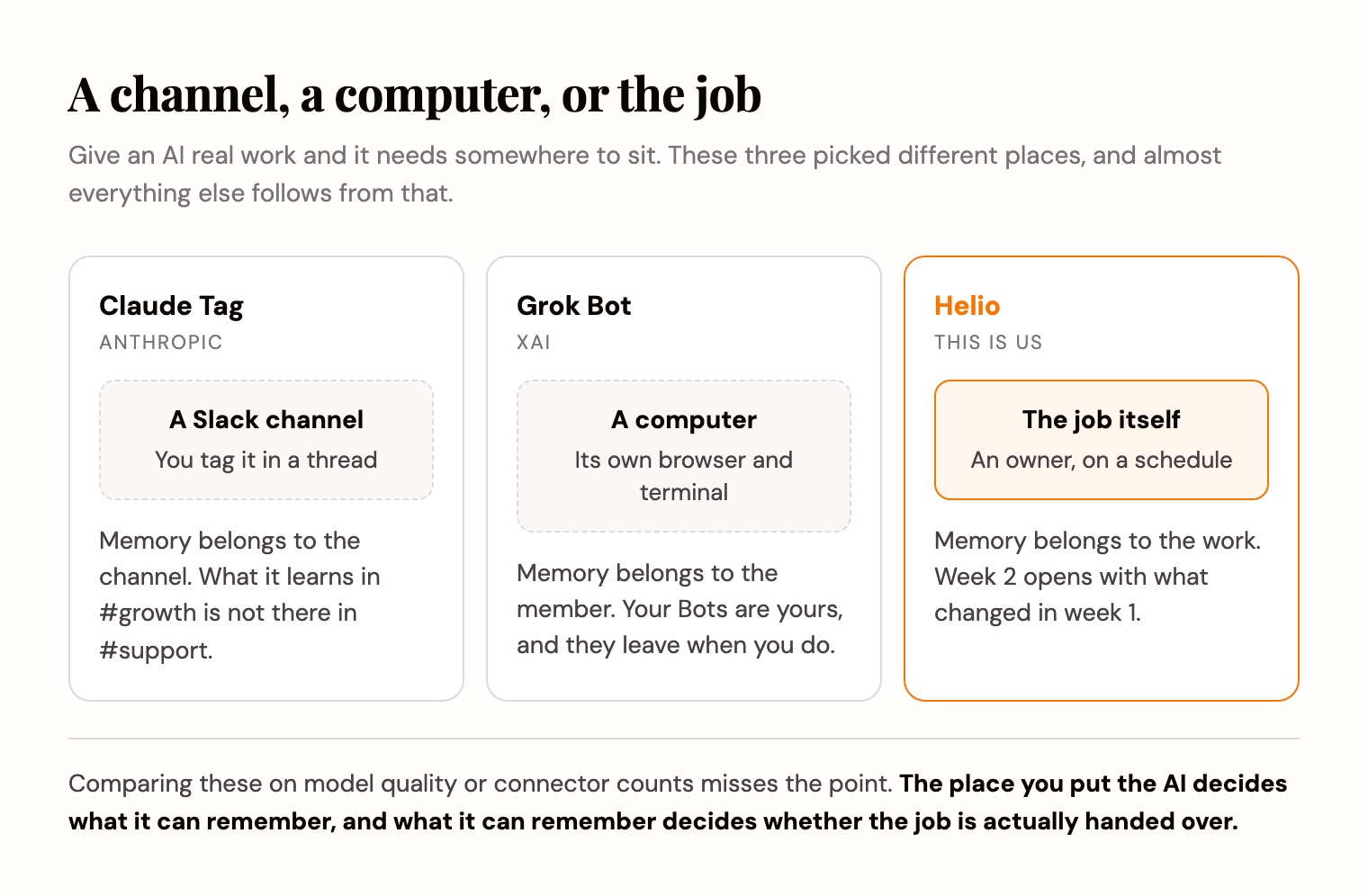
Anthropic answered: a Slack channel. xAI answered: a computer.
Almost every difference below follows from that one choice, which is why comparing them on model quality or connector counts misses the point.
What each one actually is
Precisely, because both names are misleading.
Claude Tag is Anthropic's @Claude living inside a Slack channel. You tag it in a thread, hand it a task, and it works asynchronously over minutes or hours before posting the result back. It shipped on 23 June 2026 with roughly 14 connectors, runs on Claude Opus 4.8, and replaced the earlier Claude in Slack app with a 30-day migration window.
Grok Bot is xAI's named-agent product. You create Bots, each with a short name, one primary job, and a note on how it should work. Every member gets a persistent cloud Linux machine with a browser, filesystem and terminal, shared by all of that member's Bots. That machine is what lets a Bot drive apps and websites with no clean API. It ships as a desktop app for macOS and Windows, plus iOS.
One is a guest in software your team already runs. The other brings its own building.
Side by side
The differences that decide which one you buy.
| Claude Tag | Grok Bot | |
|---|---|---|
| Where it sits | One Slack channel | A cloud computer, driven from a desktop or iOS app |
| How you reach it | Tag it in a thread | Message it in the app, or on iOS |
| What it can touch | Around 14 connectors | Connectors, plus anything a browser can reach |
| Memory belongs to | The admin-scoped channel set | The member |
| Identity in your logs | A shared agent identity | The member's own sessions |
| Agents working together | One Claude per channel | Bots message each other and pass ownership |
| Learns a workflow by | Being told | Watching you do it once |
| Runs on Linux desktop | Not applicable, it is Slack | No |
| Plan required | Claude Enterprise or Team | SuperGrok Heavy, Cursor Ultra, or Cursor Teams Premium |
| Published price | None | Plan prices only: $200/mo Ultra, $120/seat Teams |
Where Claude Tag wins
Adoption, mostly, and that is not a small thing.
Nobody installs anything. The agent is in the room where the argument about the work is already happening, so the request and the result end up in the same thread, and a colleague scrolling back sees both. For work that starts as a discussion, that is the shortest path from question to answer that anyone has shipped.
It is also the easier sell internally. Adding an app to Slack is a decision your team has made many times. Rolling out a desktop client that runs a cloud machine per person is a different conversation with a different set of people.
We took the same bet, for what it is worth. Helio teammates work in Slack channels alongside people, because the shortest path to adoption is the room the team is already in.
Where Grok Bot wins
Reach, and one thing nobody else has.
A Bot with a browser, a filesystem and a terminal can finish work in tools that never shipped an API, which covers most internal software and a good share of the web. Claude Tag reaches roughly 14 connectors and you cannot extend that list from inside Slack. If the tool you need is not on it, the comparison ends there.
The second is learning by demonstration. Walk a Bot through a multi-step path once and it keeps that path as a routine it can re-run on a schedule. Claude Tag has to be told in words, and so does Helio.
If either of those is why you are reading this, stop here and buy Grok Bot. Neither the rest of this article nor our product changes that answer.
The thing neither one does
Both products moved memory somewhere better than a chat window, and both stopped one step short.
Claude Tag scopes memory to the channel sets an admin defines. Unless rooms are scoped together, what it learned in #growth is not there in #support, so the same background gets re-explained across boundaries.
Grok Bot scopes it to a person. xAI's docs are explicit that files, sign-in sessions and access belong to the member rather than the Bot. Your Bots are yours. A colleague cannot pick up a job yours has been running for a month, and when you leave, it leaves.
Neither scopes memory to the job. That sounds like a small distinction until the work repeats.
| When the same job comes back | Claude Tag | Grok Bot | An owner model |
|---|---|---|---|
| Who remembers it is due | A scheduled task, if you set one | A routine, if you built one | It does |
| Who notices what changed | You | You | It does |
| Where last week's context lives | The channel, if not scrolled away | That member's machine | With the job |
| Who can pick it up | Anyone in the channel | The member who owns it | Anyone with access |
| What happens when they leave | It stays in the channel | It goes with them | It stays with the work |
Where we fit, and where we do not
We build Helio, so weigh this section accordingly. Helio is a workspace where AI teammates own recurring work: you give one a name, a role, and a job that comes back, and it picks that job up on its own schedule and delivers the result. It runs in Slack as well as its own channels.
Memory attaches to the job. A recurring job gets a dedicated AI teammate that keeps its own context across every run, delivers on a schedule, and sits in a workspace your colleagues are in. You invite people by email, and each teammate gets its own dedicated Slack app rather than one shared bot identity, so your logs name the teammate that did the work.
What we do not have is Grok Bot's computer. A Helio teammate can drive your own paired Chrome browser on sites without an API, but there is no persistent cloud machine of its own, and it cannot learn a workflow by watching you do it once. If either of those is the reason you are shopping, buy Grok Bot, and we would rather say so than talk around it.
We also do not run in Microsoft Teams. Neither does Claude Tag today, so on that one the three of us are even.
If you want the wider field rather than these two, we compared them in Grok Bot alternatives and Claude Tag alternatives.
What neither has published
A usage rate.
Claude Tag bills against token-based spending with admin spend controls, on Claude Enterprise and Team plans, and Anthropic has not released a per-seat or per-token rate. Grok Bot's gating plans do carry published prices — Cursor Ultra at $200 a month, Cursor Teams Premium at $120 per seat, and it is included with SuperGrok Heavy — but what running Bots costs beyond the included allowance is not published. It also signs in with a Cursor account, a second vendor before you start.
For Claude Tag the cost drivers are worth understanding before you switch it on, because two of the three are not you asking for anything. We went through them in Claude Tag pricing.
We publish ours, which is easy to say and worth saying anyway: Helio starts free with 1,000 credits and no card, then $16 a month billed annually, with the per-credit rate on the pricing page. That is a different claim from being cheaper. Neither of these has told anyone what the usage costs.
A note on the sourcing
These two are not equally documented, and that shapes what anyone can honestly claim about them.
Claude Tag has been out since June and has been written about widely, so the facts here are cross-checked against several independent write-ups as well as Anthropic's own material. Grok Bot is newer and almost everything published about it comes from xAI. The facts above are from its documentation, which is a primary source and also an interested one.
Treat the Grok Bot column as accurate about intent and unverified about experience. Nobody outside xAI has run it long enough to say how the computer behaves on a bad day.
How to choose
Three questions, in the order that settles it fastest.
- Where does the work start? In a conversation, Claude Tag is the shortest path. In a tool with no API, Grok Bot's own persistent computer reaches it without borrowing yours.
- Whose work is it? Claude Tag makes it the channel's. Grok Bot makes it that member's. If a colleague has to be able to pick it up, neither scope is what you want.
- How many times will you ask for it? Once suits either. Every Monday, both can re-fire, a scheduled task in a channel or a routine on a member's machine, but the job still has no owner, and that is the case Helio is built for: the job gets an owner instead of a channel or a machine, and it runs again without you.
The one-line version
Anthropic gave the AI a channel. xAI gave it a computer. Both are real answers to where an AI should sit, and which one fits depends on where your work already happens. For a lot of teams one of them is the right purchase, and this article has tried to say which.
The question left over is what happens the second time. If you are the one who remembers, you have not handed the job over yet, whichever of the two you bought.
That is the third answer, and it is the one we build. Helio gives the job an owner rather than giving the AI a room. A recurring job gets a named AI teammate that keeps its own memory across every run, works in your Slack channels, and delivers the weekly result because it is Monday, not because someone remembered. It starts free with 1,000 credits and no card, so the cheapest way to find out whether the distinction is real for your team is to hand it one job that comes back.
Frequently asked questions
What is the difference between Grok Bot and Claude Tag?
Claude Tag is Anthropic's @Claude living inside a Slack channel: you tag it in a thread and it posts the result back. Grok Bot is xAI's named-agent product, where each member gets a persistent cloud computer with a browser, filesystem and terminal, driven from its desktop and iOS apps. One sits in software your team already runs; the other brings its own environment.
Which is better, Grok Bot or Claude Tag?
Neither, in general. Claude Tag is better when the work starts in a Slack conversation and everyone should see it. Grok Bot is better when the work happens in tools that have no API, because a browser and a filesystem can reach what connectors cannot.
Does Grok Bot work in Slack?
Grok Bot is driven from a desktop app for macOS and Windows, plus iOS, rather than from a Slack channel. Bots can be pointed at Slack as one of the tools they use, but the product does not live in a channel the way Claude Tag does.
How much do Grok Bot and Claude Tag cost?
Neither publishes a usage rate. Claude Tag bills against token-based spending on Claude Enterprise and Team plans. Grok Bot comes with Cursor Ultra at $200 a month or Cursor Teams Premium at $120 per seat, is included with SuperGrok Heavy, and signs in with a Cursor account; usage beyond the included allowance has no published rate.
Do either of them remember work between runs?
Both persist something, but not the same thing. Claude Tag keeps memory scoped to admin-defined channel sets, so it does not follow work between rooms by default. Grok Bot keeps memory, files and browser sessions per member. Neither attaches memory to the job itself, which is what Helio does: a recurring job gets an owner that keeps its own context across every run and delivers on a schedule.
Can Grok Bot use apps that have no API?
Yes, and it is the main reason to pick it. Bots run on their member's cloud machine with a real browser, so they can sign in and act in a website the way a person would. Claude Tag reaches roughly 14 connectors and cannot be extended from inside Slack.