Claude Tag pricing: what it actually costs
Helio Team
Claude Tag pricing has no published rate. What is actually known about the cost, what drives the bill, and what a published price looks like instead.
What Anthropic has actually said
Short version: not much, and that is the story.
Claude Tag is billed as token-based spending with administrative controls, on Claude Enterprise and Team plans. There is no per-seat rate, no per-message rate, and no published allowance. It shipped on 23 June 2026 and replaced the earlier Claude in Slack app, giving existing users a 30-day window to migrate onto a billing model that nobody outside Anthropic has been able to price with any confidence.
Compare that to what its neighbours publish, us included. Helio is $16 a month billed annually for 9,000 credits, and the per-credit rate sits on the page. Slack Pro is $7.25 per user per month billed annually. Microsoft 365 Copilot is $30 per user per month billed annually. eesel charges $0.40 per resolved ticket. Lindy runs $29.99, $99.99 and $199.99 across three tiers. You can model any of those on a napkin before a sales call. Claude Tag you cannot.
What published pricing looks like elsewhere
The point of this table is not that Claude Tag is expensive. Nobody knows whether it is. The point is which of these you can price yourself.
| Tool | Pricing model | Published rate |
|---|---|---|
| Claude Tag | Token-based spend, admin controls | None |
| Helio | Credits, monthly plans | Free tier, then $16/mo |
| Slack Pro | Per seat | $7.25 per user/mo, annual |
| Microsoft 365 Copilot | Per seat | $30 per user/mo, annual |
| eesel AI | Per resolved ticket | $0.40 per ticket |
| Lindy | Monthly tiers | $29.99 / $99.99 / $199.99 |
| Glean | Per seat plus credits | None, quote only |
What actually drives the bill
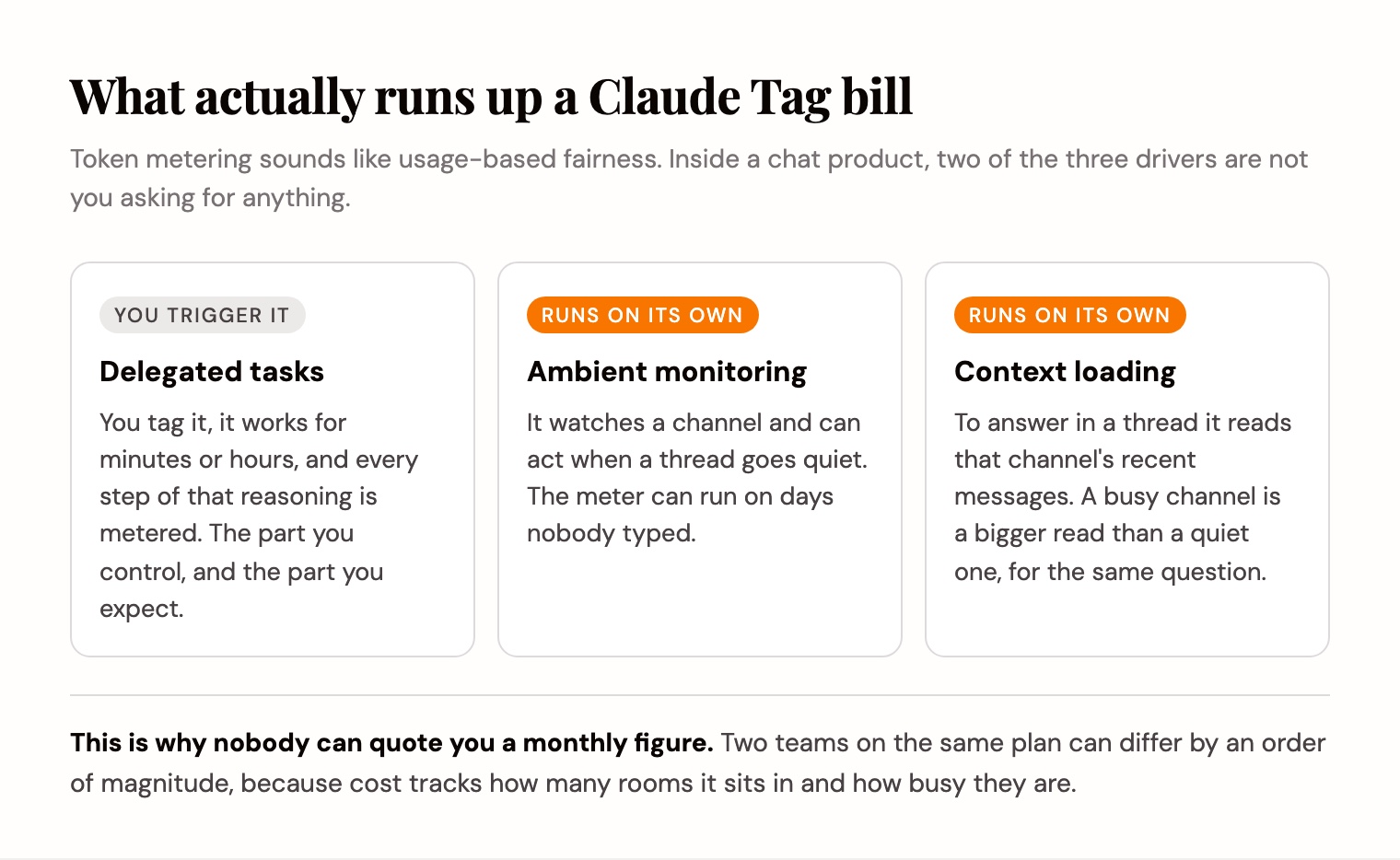
Token metering sounds like usage-based fairness. Inside a chat product it behaves differently, because two of the three cost drivers are not you asking for anything.
- Delegated tasks. You tag it, it works for minutes or hours, and every step of that reasoning is metered. This is the part you control and the part you expect.
- Ambient monitoring. Claude Tag can watch a channel and act when a thread goes quiet. Useful, and it means the meter can run on days nobody typed.
- Context loading. To answer inside a thread it reads the recent messages in that channel. A busy channel is a bigger read than a quiet one, for the same question.
The concern people raised at launch
This was the top reply on Hacker News when Claude Tag shipped, and it remains the clearest statement of the risk anyone has written: the worry is that parsing all messages across N channels, plus ambient monitoring, is going to consume a lot of tokens.
Anthropic has not disputed the shape of that. Access scoping decides what Claude Tag can reach, and what it can reach is also what it reads.
Why nobody can quote you a monthly figure
Your bill depends on how many channels it sits in, how busy those channels are, and how often people delegate to it. Two teams on the same plan can differ by an order of magnitude.
Credits behave differently, which is the reason we chose them. A Helio teammate consumes credits when it does the work you assigned, not when a channel it happens to sit in gets busy.
That is not unique to Anthropic. It is what happens when a product meters reading as well as writing, then lives somewhere that generates reading whether or not anyone asked for it.
VentureBeat flagged the cost profile as a buyer risk at launch. That is the right posture. Not that it is overpriced, but that it is unpriced, and unpriced is hard to get approved.
What to do before you switch it on
Five checks, in the order that saves the most money.
- Set an admin spend cap first. The controls exist. Use them before week one, not after the first invoice.
- Start it in one channel, not ten. Ambient monitoring scales with the number of rooms it watches.
- Pick a quiet channel for the pilot. A room doing 200 messages a day is the worst place to measure a baseline.
- Log what you delegated. When the bill arrives you want to know which tasks were worth it, and a channel history is not a cost report.
- Confirm you are on Enterprise or Team. If you are not, none of the above applies, because you cannot turn it on at all.
What we do, since we are about to quote you a price
We build Helio, so treat this section and the next as interested rather than neutral. Here is what it is, in case the name is new.
Helio is a workspace where AI teammates own recurring work. You hire one roughly the way you would hire a person: give it a name, a role, and a job that comes back. It picks that job up on its own schedule, does the work in your connected tools, and delivers the result where your team already looks. Nobody re-prompts it on Monday.
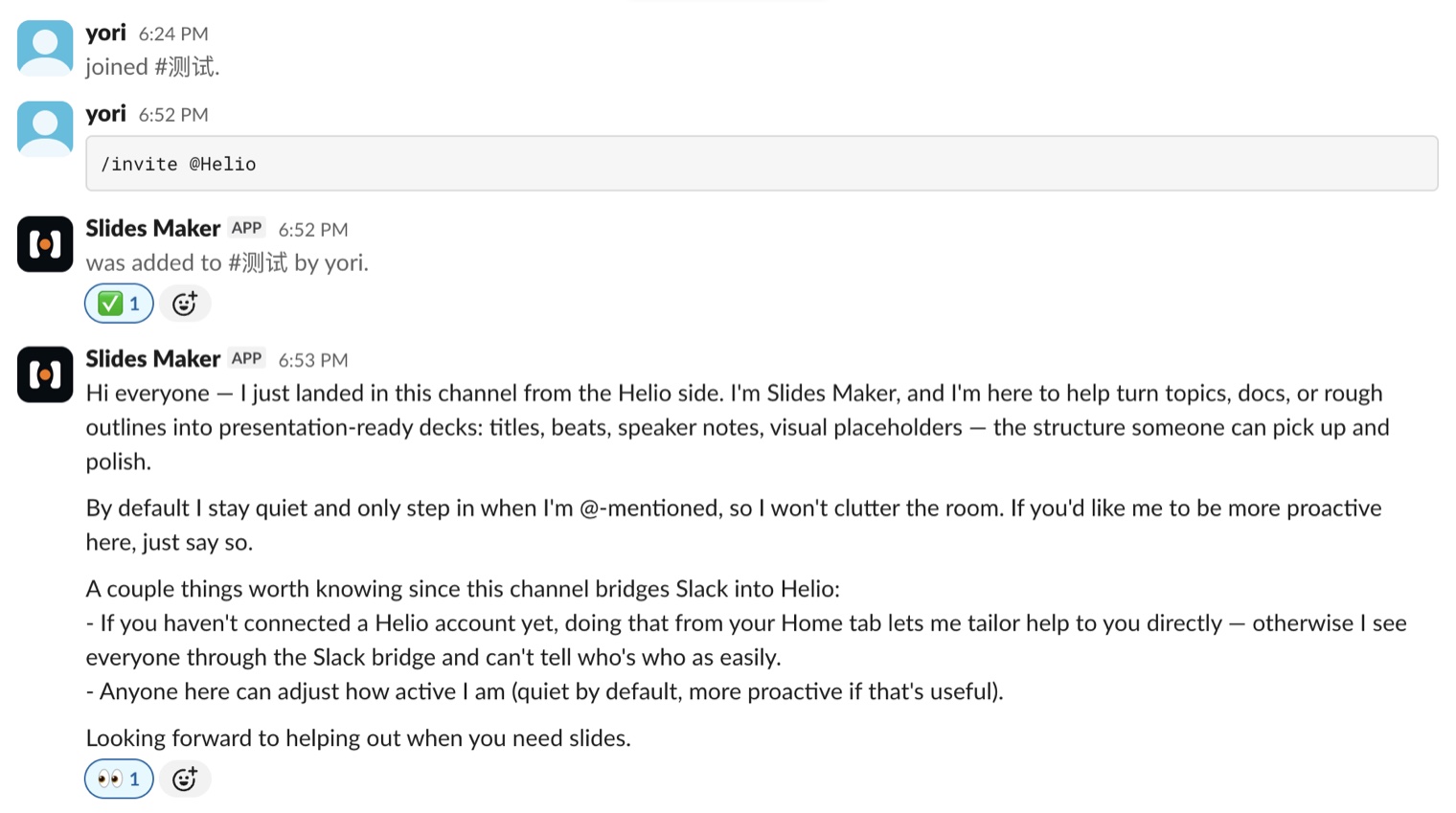
It works in Slack too, which is the part people assume it does not. A Helio teammate gets its own dedicated Slack app, posts into your channels, and answers when you mention it, so moving off Claude Tag does not mean leaving the place your team already talks. What changes is what happens between mentions. Claude Tag can schedule follow-ups of its own, but each run stays a task inside that channel's scope. A Helio teammate owns the job itself and is already working on the next run.
It is not a swap in both directions, and we would rather say so before the price table. Claude Tag reaches further into a Slack workspace than we do, and if what you want is an agent to tag ad hoc in any thread, it is the better fit. If the same work comes back every week, an owner beats a task runner and the bill is easier to predict, which is the rest of this article.
If a predictable number is what you are after
Plenty of teams are fine with metered spend. If you are not, the useful question is not which tool is cheapest. It is which tool lets you know the number before you commit.
Helio publishes its rates. Credits meter model usage at 200 credits per dollar, and the plan page shows the per-credit rate at every tier, so the arithmetic sits on the page rather than inside a quote.
The deeper difference is what you are buying. Claude Tag meters a teammate that answers when tagged. In Helio you hand a recurring job to a teammate that owns it, and what you pay for is the weekly result, not the conversation that produced it.
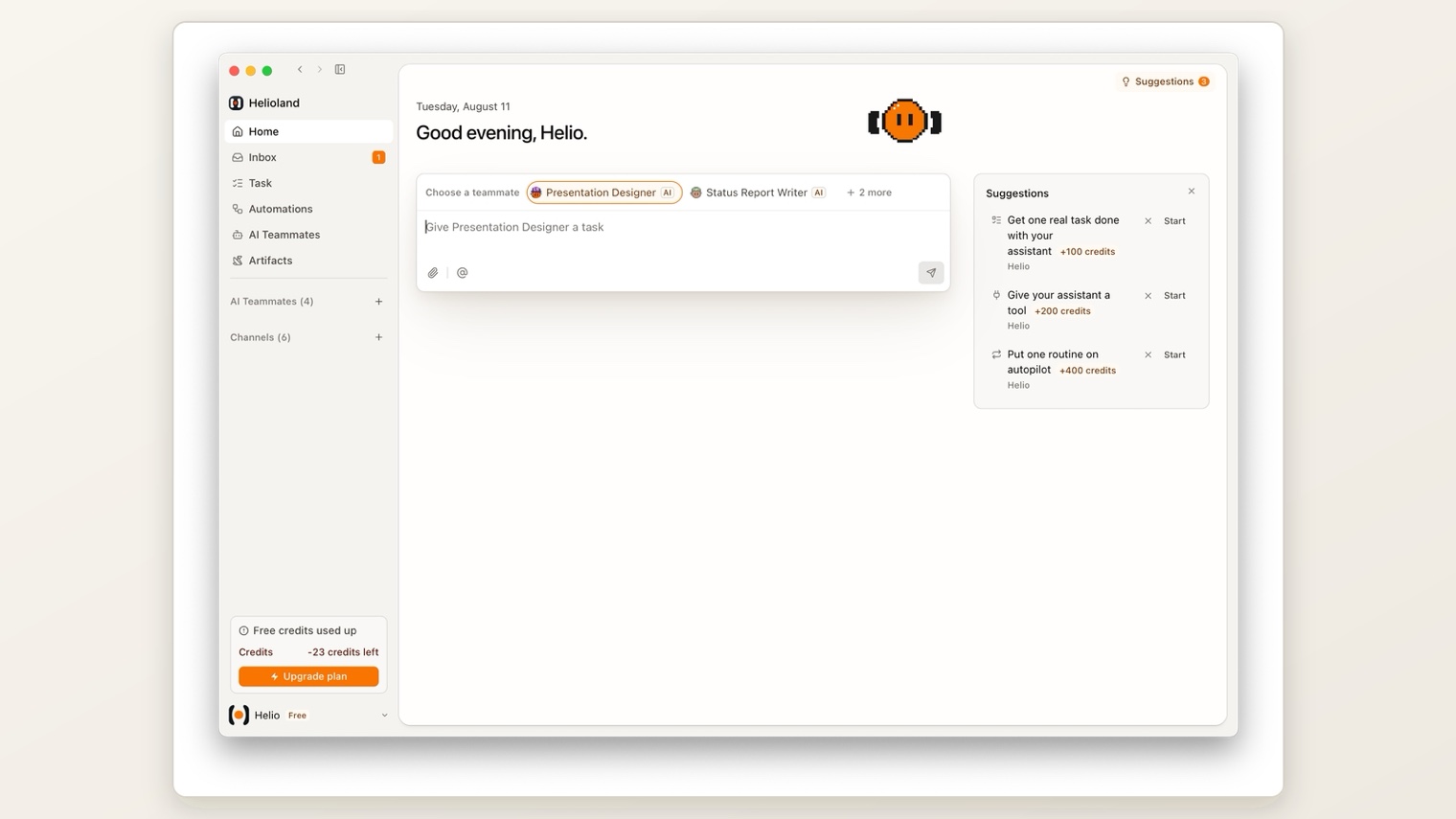
- Free: $0, 1,000 credits one-time, 5 AI teammates, 3 scheduled tasks, no card.
- Pro: $16/mo billed annually ($20 monthly), 9,000 credits, 20 teammates, 20 scheduled tasks.
- Max: from $80/mo, 55,000 credits, 100 teammates, full cross-session memory.
- Every tier is on the pricing page, including the per-credit rate.
Frequently asked questions
How much does Claude Tag cost?
Anthropic has not published a per-seat or per-token rate. Claude Tag bills against token-based spending with administrative spend controls, and it is available on Claude Enterprise and Team plans only. Actual cost depends on how many channels it monitors and how much work gets delegated to it.
Is Claude Tag free?
No. It is not offered on free or individual Claude plans. It comes with Claude Enterprise and Team plans, and the usage it generates is billed against token spending on top of that plan.
Does Claude Tag have a per-seat price?
No published one. Unlike Slack Pro at $7.25 per user per month or Microsoft 365 Copilot at $30 per user per month, Claude Tag is metered on usage rather than headcount, so cost tracks activity instead of team size.
What makes a Claude Tag bill go up?
Delegated tasks, ambient monitoring of the channels it sits in, and the context it reads to answer inside a thread. Only the first is something a person actively triggers, which is why a busy channel can cost more than a quiet one for the same question.
Can I cap Claude Tag spending?
Yes. Anthropic describes token-based spending with administrative controls, so an admin can set limits. Set the cap before the first week rather than after the first invoice.
Is there an AI teammate with published pricing?
Several. Helio starts free with 1,000 credits and no card, then $16 a month billed annually. eesel charges $0.40 per resolved ticket. Lindy publishes three monthly tiers. If a predictable number matters more than a specific model, those are the shortlist.