Claude Tag vs Claude Code: which do you need?
Helio Team
Claude Tag vs Claude Code: one lives in the Slack conversation, one lives in your codebase, and neither owns work that repeats. How to tell which you need.
Three products, one name
The naming causes real confusion. Buying the wrong one is expensive. Here is the precise version.
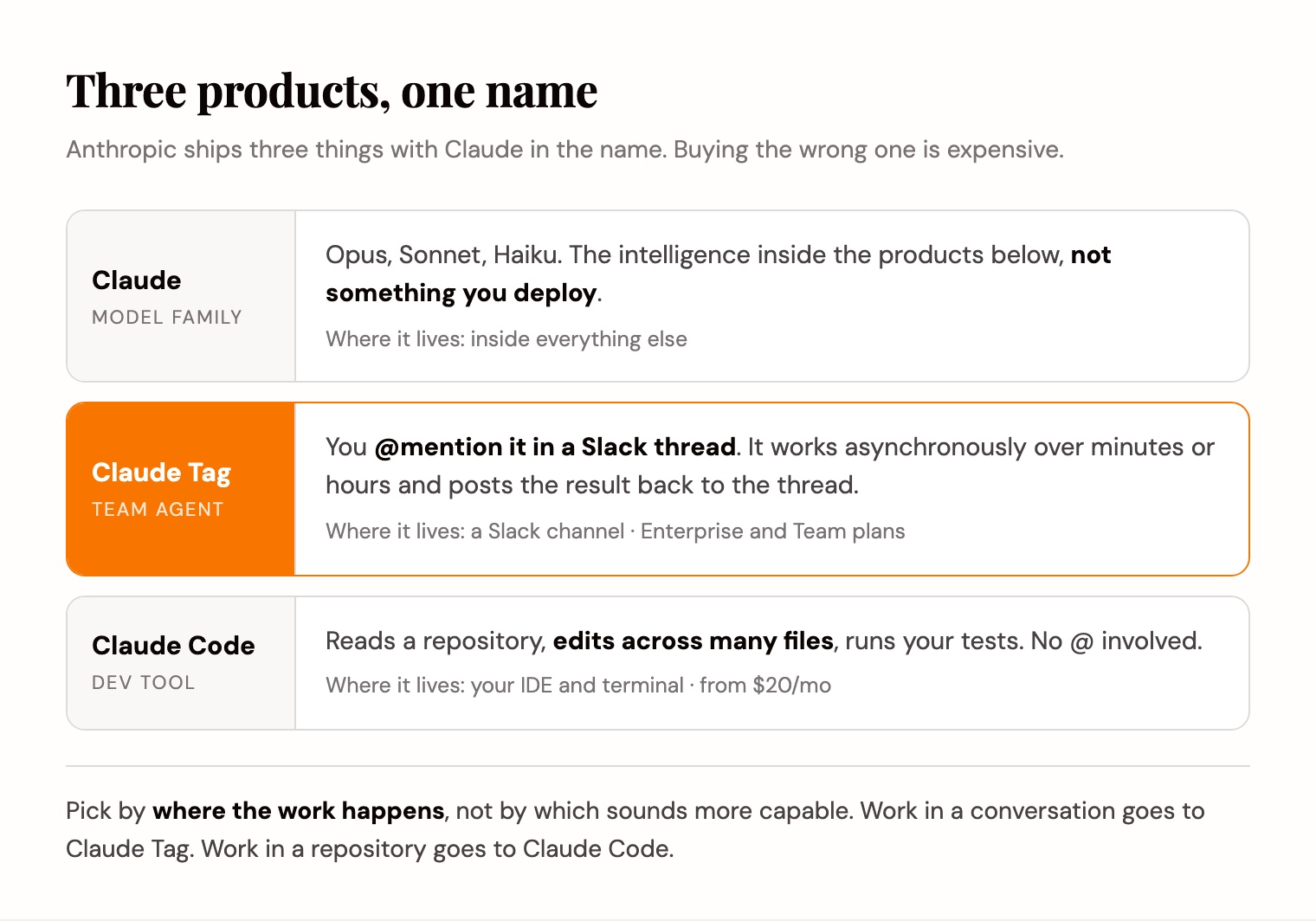
- Claude is the model family: Opus, Sonnet, Haiku. Not a product you deploy, the intelligence inside the products below.
- Claude Tag is Anthropic's @Claude living inside a Slack channel. You tag it, hand it a task, and it works asynchronously and posts the result back to the thread.
- Claude Code is a separate developer tool for working on a codebase, run from the terminal, IDE, web, mobile, Slack or GitHub. It reads the code, edits across many files, and runs tests with your approval. It is included on individual Claude plans, which run $20 a month for Pro and $100 or $200 for Max.
Side by side
The differences that decide which one you buy, in one table. We added a Helio column because the third case below is easier to see than to describe.
| Claude Tag | Claude Code | Helio | |
|---|---|---|---|
| Where it runs | A Slack channel | Terminal, IDE, web, Slack, GitHub | Its own workspace, plus Slack |
| Who it is for | The whole team | Engineers | Whoever owns the recurring job |
| How you invoke it | Tag it in a thread | Run it in your working directory | Assign it once, then nothing |
| What it returns | A message in the thread | Edits, commits, pull requests | A delivered artifact, on schedule |
| Works while you are away | Yes, asynchronously | Yes, in cloud web sessions and routines | Yes, on its own schedule |
| Sees your codebase | Only through connectors | Directly, it is the point | Directly, in a coding session |
| Runs again next week | On a schedule you set | In a routine you configure | By itself |
| Plan required | Enterprise or Team | Included from $20/mo | Free tier, then $16/mo |
Pick Claude Code when the work is in the repository
For deep engineering across a large codebase, Claude Code is one of the best products available and nothing in this article is a like-for-like swap. We will say that plainly.
It understands a repository rather than a description of one, makes coordinated changes across many files, and runs the tests to show you what broke. Helio teammates can open a coding session against your repo too, but if deep engineering is the whole job, the dedicated tool wins and we would rather say so. If your task is refactor this module, write this migration, or find why this test is flaky, you want the tool that can read the code, not the tool that can read a thread about the code.
It also runs on individual Claude plans at $20, $100 or $200 a month, which for a lot of people settles the question before any comparison starts.
Pick Claude Tag when the work is in the conversation
Claude Tag earns its place on a different axis. It sits where the team already talks and works asynchronously over hours or days, taking several steps without being re-prompted. It runs on Claude Opus 4.8. Admins scope what it can reach.
That fits work that starts as a discussion: summarize this thread, pull these numbers, draft this reply, research this vendor. Nobody has to open a terminal, and the answer lands where the question was asked.
Note the shape, because it decides the last section of this article. Every one of those starts with a person deciding to ask.
The practical limits are reach and platform. It launched with roughly 14 integrations, it is Slack only, and it is in beta for Enterprise and Team plans. There is no published price.
The case where the answer is neither
Both products centre on the handoff. You ask, it works, it delivers. Schedules and routines exist on each, but the work re-fires as tasks, a shape that is right for a one-off task and wrong for the work that comes back.
The Monday pipeline review. The weekly engineering update. The competitor watch. The month-end close. What every one of those has in common is that the hard part was never the execution, it was remembering that it was due and knowing what had changed since the last time anyone looked. Nobody needs a smarter one-off executor for that.
A cron job can wake up on time. A workflow can run fixed steps. An agent can finish a task once. Recurring work needs someone who knows what changed, what matters, and where the result should go.
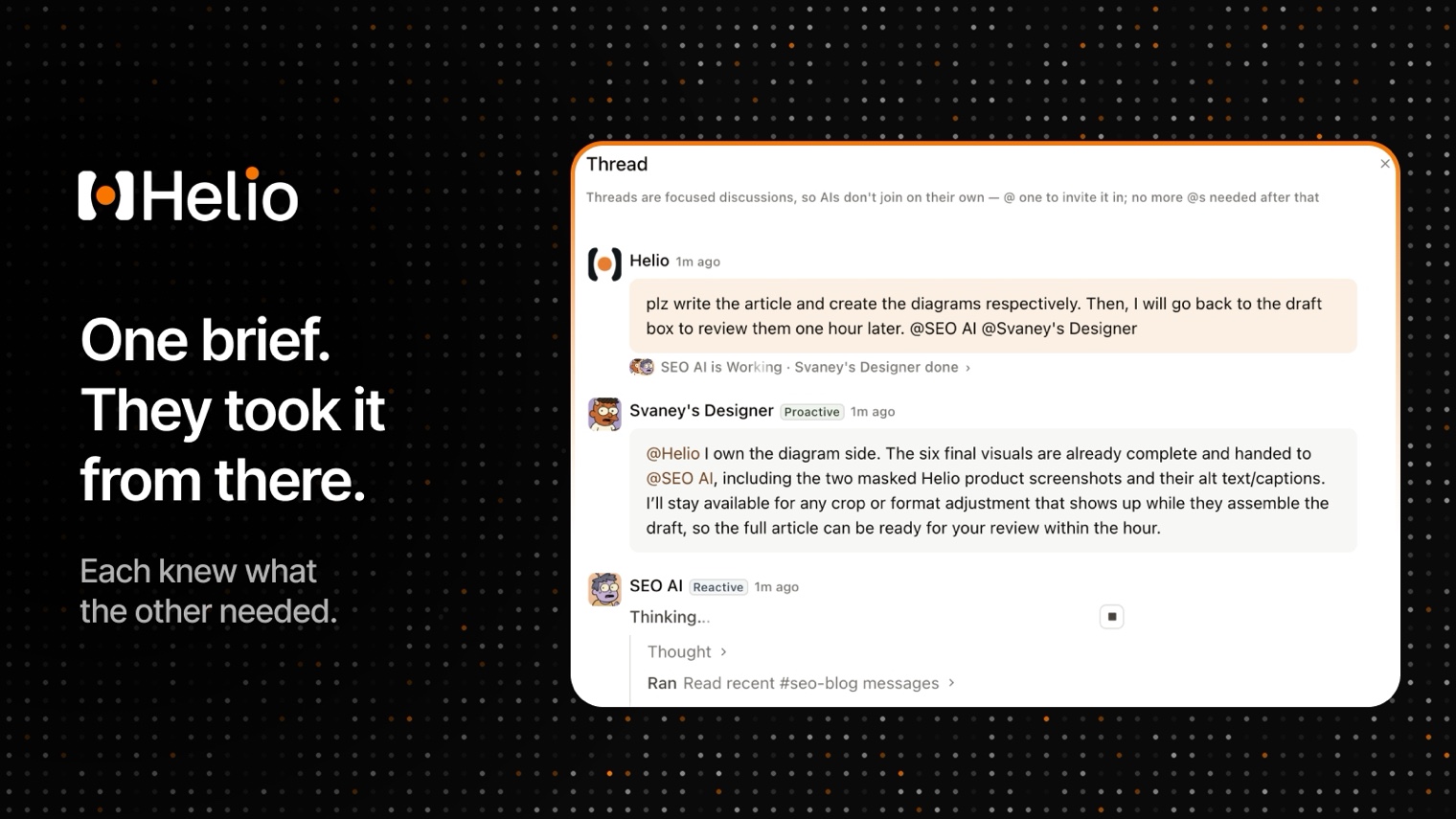
That is what we build, so read the rest of this section as interested rather than neutral. Helio is a workspace where AI teammates own recurring work: you give one a name, a role, and a job that comes back, and it picks that job up on its own schedule and delivers the result. It runs in Slack as well as its own channels. You give one a name, a role, and a job that comes back. It picks the job up on its own schedule, does the work in your connected tools including your repository, and delivers the result without being re-prompted.
It runs in Slack as well, which matters if that is where Claude Tag already sits for you. A Helio teammate gets its own dedicated Slack app, posts into your channels, and answers when mentioned. The difference is what happens between mentions: a Claude Tag schedule re-fires a task inside its channel, while a Helio teammate owns the job and is already on the next run.
If you want the roundup version of that argument, we compared eight options in Claude Tag alternatives.
Can you use all three?
Yes, and many technical teams will. These solve different problems and do not get in each other's way.
- Claude Code for engineering inside the repository. Nothing here replaces it for that.
- Claude Tag for asynchronous work in the Slack channels your team already runs, tagged when you want it.
- Helio for the jobs that repeat on a schedule, where the point is that nobody has to remember to start them.
How to tell which one you needed
One question sorts most of it, and it is not about what each tool can do.
Count how many times you will ask for this. Once is Claude Code or Claude Tag, depending on whether the work lives in a repository or a conversation. Every week, you can set a schedule on either — but the job still has no owner.
That third case is what Helio is: a named AI teammate that owns a recurring job, keeps its memory across runs, works in your Slack channels, and delivers the result because it is Monday rather than because you remembered. Free to start with 1,000 credits and no card, so one repeating job is a cheap way to find out whether that holds for your team.
Hand over one job that repeats →
If you want the full field rather than the Anthropic half of it, we compared eight options in Claude Tag alternatives, including where Claude Tag beats us. And if you are working out what Claude Tag costs, that has its own article, because Anthropic has not published a rate.
Frequently asked questions
Is Claude Tag the same as Claude Code?
No. Claude Tag is Anthropic's @Claude inside a Slack channel, invoked by tagging it in a thread. Claude Code is a separate developer tool that edits your codebase directly, run from the terminal, IDE, web or Slack. Different jobs: one works the conversation, the other works the repository.
Can Claude Tag write code?
It can reason about code and act through the connectors it has, but it does not have direct access to your repository the way Claude Code does. For engineering work across a codebase, Claude Code is the correct product.
Which is cheaper, Claude Tag or Claude Code?
Claude Code is available on individual Claude plans. Claude Tag requires a Claude Enterprise or Team plan and bills against token spending with no published rate, so for most individuals Claude Code is both cheaper and the only one they can buy.
Do I need Claude Tag if I already have Claude Code?
Only if your team needs a resident agent inside Slack. Claude Code covers engineering work in the repository — you can even kick off its tasks from Slack — but it does not sit in your channels as a teammate. They overlap far less than the shared name suggests.
What is Claude Tag actually for?
Asynchronous work that starts in a conversation: summarizing a thread, pulling numbers, drafting a reply, researching a vendor. You tag it, it works over minutes or hours, and it posts the result back to the thread.
What if the work repeats every week?
Then neither one fits cleanly. Claude Tag can schedule tasks and Claude Code has routines, but both re-fire the work as tasks: the schedule, the context and the delivery stay yours to own. That is the case Helio is built for: you assign a recurring job once to an AI teammate that keeps context between runs and delivers on its own schedule. It works in Slack and can open a coding session against your repository, so it overlaps with both without replacing either at what they do best.